.png?width=500&height=136&name=4J%20commercial%20insurance%20broker%5B1%5D%20(1).png)
2027 ACA Contribution Calculator for Employers
What Is the 2027 ACA Affordability Standard?
For 2027, the ACA affordability limit is 10.22%. This calculator helps employers see whether employees may be paying too much, the company may be contributing more than necessary, or the current contribution strategy is in the right range for 2027. Could a few dollars per employee add up across your workforce?
For 2027, the Federal Poverty Line method sets the monthly affordability limit at $135.926. This calculator uses the exact amount to help you see whether your company may be contributing too much, too little, or about right before finalizing your 2027 benefits strategy.
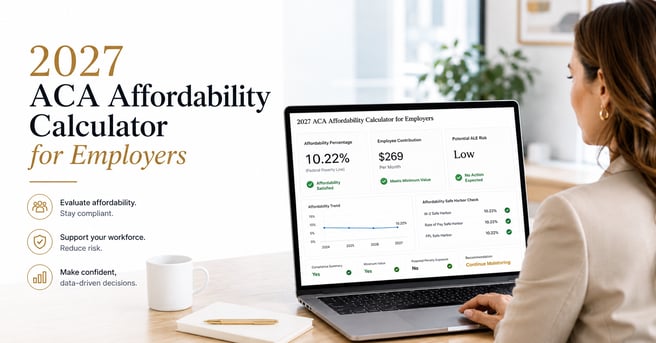
Are You Over-Contributing, Under-Contributing, or Optimized?
Your 2026 contribution strategy may not be the right strategy for 2027.
For 2027, the affordability rate is going to 10.22%.
Employers have more flexibility with their contribution structure, which means your company could be spending more than necessary, asking employees to pay too much, or sitting right where you want to be.
The goal is not to contribute less. It is to know whether every benefits dollar is being spent intentionally.
Could Your 2026 Contribution Strategy Be Costing You in 2027?
Possibly — and a few dollars per employee can add up quickly.
The 2027 Federal Poverty Line affordability screen is $6.031 higher per employee per month than 2026. That difference is about $3,600 a year for 50 employees — and nearly $145,000 a year for 2,000 employees.
Scale changes the math. Your contribution strategy should account for it.
2027 BENEFITS PLANNING TOOL | EMPLOYER CONTRIBUTION STRATEGY
2027 ACA Contribution Strategy Calculator for Employers
Measure employer contribution headroom, model your 2027 benefit costs, and verify ACA affordability before your benefits strategy is finalized.
1. Your Current Contribution Strategy
2. Your Workforce
Are your employees split among multiple companies?
Does the same owner or ownership group employ people through more than one business, LLC, corporation, partnership, or EIN?
Why we're asking Some businesses operate through multiple legal entities under the same or related ownership. For ACA Applicable Large Employer screening, employees of certain commonly owned or related businesses may need to be considered together. This calculator uses the information you provide to identify a potential aggregation issue, but it does not determine whether the entities are legally required to be aggregated under IRC §414. Example One ownership group operates Company A, Company B, and Company C. Each company employs 20 people. Although each company individually has fewer than 50 employees, the combined workforce is 60. Depending on the ownership structure, those employees may need to be considered together when determining ACA Applicable Large Employer status.Tell us about the other businesses in the ownership group
Enter workforce information for the other companies or entities that share common or related ownership with the employer you are evaluating.
Are employees from these related businesses covered under the same medical plan you are evaluating?
We ask because related businesses may be combined for ACA/ALE workforce screening even when they do not all participate in the same medical plan. Only employees participating in the plan being evaluated should be included in this participation screen.3. ACA & Plan Screening
4. Participation & Marketability
This section is a Texas group-health marketability / carrier participation screen. It is not an ACA compliance test.
Confirm which related businesses participate in this medical plan before relying on the participation result.
2027 CALENDAR-YEAR ACA AFFORDABILITY CALCULATOR
This early-access affordability screen is configured for plan years beginning January 1, 2027. The exact monthly FPL safe-harbor screening amount for the contiguous states and D.C. is $135.926, calculated from a $15,960 one-person poverty guideline and the 10.22% percentage (approximately $135.93). Because employee contributions are typically charged in whole cents, this calculator treats $135.92 as the conservative maximum monthly amount that does not exceed the unrounded threshold; entered amounts of $135.93 or more trigger the conservative review flag below.
Non-calendar-year plans may require a different applicable Federal Poverty Line. Employers may also use W-2 or Rate of Pay safe harbors. This educational tool does not make a formal compliance determination or IRS filing position.
2027 indexed amounts
Potential indexed employer shared responsibility amount: §4980H(a) annual $3,780 ($315.00 monthly equivalent) and §4980H(b) annual $5,670 ($472.50 monthly equivalent). The IRS determines actual liability based on applicable facts; these are not automatic fines or amounts owed.
Authority
IRS Revenue Procedure 2026-26, Section 3.02; IRS Revenue Procedure 2026-22; IRS Employer Shared Responsibility Questions and Answers; IRS Minimum Value and Affordability guidance; HHS/ASPE 2026 Poverty Guidelines.
2027 ACA calculator FAQ
Does $135.93 apply to every 2027 plan?
No. This early-access screen assumes a January 1, 2027 calendar-year plan. Later plan years may use a different applicable poverty guideline.
Does the screen calculate a fine?
No. It provides an educational screen only and does not calculate employer shared responsibility liability.
Educational screening only. This is not legal, tax, accounting, actuarial, payroll, ERISA, or formal ACA compliance advice. Results depend on the information entered and facts not collected here.
What the tool asks for, and why
- Enter your full-time employee count — anyone averaging 30 hours per week or 130 hours in a month.
- Enter your part-time headcount and their average weekly hours; the tool converts these into full-time equivalents.
- Add any businesses under common ownership so the group is tested together.
- Enter the percentage of full-time employees you offer coverage to, and the monthly self-only employee cost.
- Read the result as a prompt to investigate, then confirm it against your actual plan documents and payroll data.
Carrier Access for Texas Employers
We help Texas employers evaluate group health and level-funded options across a broad range of carrier markets.












How the calculation works, and what it assumes
- Non-full-time employee hours are converted using the 120-hour divisor, with hours capped at 120 per employee per month for the FTE calculation.
- Full-time status is screened at 30 hours per week or 130 hours per month.
- Affordability is screened using the Federal Poverty Line safe harbor.
- Common-ownership information is accepted as entered; the calculator does not determine whether entities form a controlled or affiliated service group under §414.
- Results use the 2027 figures built into this calculator.
The calculator is a planning and screening tool. Results depend on the accuracy and completeness of the information entered.
ALE Status & Common Ownership
A “Not an ALE” result depends on the workforce information entered. Missing hours of service, paid leave, or related entities could change the result.
An “Affordability Risk” result means the Federal Poverty Line method did not clear the screen. It does not automatically mean a penalty is owed. The W-2 or Rate of Pay safe harbors may produce a different result.
Related businesses may need to be counted together when determining ALE status. This calculator uses the ownership information you enter but does not determine whether a controlled group, affiliated service group, or other aggregation relationship exists under applicable law.
Employers with multiple entities or complex ownership structures should confirm the appropriate aggregation analysis with qualified advisers.
Calculator results are planning indicators, not legal determinations or filing positions.
What Should I Do With My Result
Clearly under 50
Document the calculation and review ALE status annually, particularly as your workforce grows.
Near 50
Recalculate using actual monthly hours of service and review whether related entities must be counted together.
50 or more
Confirm ALE status using complete prior-year workforce data and review your employer-mandate and reporting responsibilities.
ALE + affordability screen clears
Document the safe harbor being used and confirm the plan's other ACA requirements before implementation.
ALE + affordability risk
Review the contribution structure, safe-harbor options, minimum value, and applicable plan terms before the plan year begins. Legal or tax questions should be reviewed with qualified counsel or a tax adviser.
Need help turning the result into a 2027 benefits strategy? Request a 4J Benefits Review
2027 Employer Mandate Penalty Amounts
For 2027, the ACA employer mandate uses the following indexed penalty amounts for Applicable Large Employers (ALEs):
- §4980H(a): $3,780 per year ($315 per month) — may apply when an ALE fails to offer qualifying health coverage to at least 95% of its full-time employees and their dependents, and at least one full-time employee receives a Marketplace premium tax credit.
- §4980H(b): $5,670 per year ($472.50 per month) — may apply for each full-time employee who receives a Marketplace premium tax credit because the coverage offered was unaffordable or did not provide minimum value.
These are not automatic fines. Actual liability depends on the employer’s workforce, coverage offered, employee eligibility for premium tax credits, and other applicable facts.
Related businesses may need to be counted together when determining ALE status, although the calculator does not determine whether a controlled group or other §414 aggregation relationship exists.
Authority: IRS Revenue Procedure 2026-22 and IRS Employer Shared Responsibility guidance.
Sources & Methodology
- Rev. Proc. 2026-26, § 3.02 — Internal Revenue Service (plan year 2027)Supports: The required contribution percentage the tool applies. Verified 16 August 2026
- Determining if an Employer is an Applicable Large Employer — Internal Revenue Service Supports: The counting method the tool implements. Verified 16 August 2026 2027 Employer Shared Responsibility Payment Amounts: Rev. Proc. 2026-22, § 2 — Internal Revenue Service (plan year 2027)Supports: 2027 Employer Shared Responsibility Payment Amounts under IRC § 4980H(a) and § 4980H(b). The 2027 values are:§ 4980H(a): $3,780 annually§ 4980H(b): $5,670 annually. Verified 16 August 2026
Explanatory guidance
- Determining if an Employer is an Applicable Large Employer — Internal Revenue Service Supports: The counting method the tool implements. Verified 16 August 2026
Last reviewed 16 August 2026. Next review: upon publication of any IRS or HHS guidance that materially affects the 2027 affordability calculations, or before publication of the 2028 ACA affordability calculator. The tool currently applies 2027 plan-year figures only; and is maintained separately from the 2026 ACA Affordability Calculator. 4J Insurance is an independent commercial insurance brokerage, powered by PGI, based in Frisco, Texas. This tool provides general educational and planning information and does not constitute legal advice, tax advice, actuarial advice, or a determination of ACA compliance.
Related resources
Continue learning
- What is an applicable large employer?
- How to calculate full-time equivalent employees
- ACA affordability and the safe harbors
- ACA compliance resources
Use a tool
Benefits tools and decision support: the rest of the tool cluster
Discuss the issue
Request an ACA compliance review: if the screen flags exposure, this is the next step
2027 ACA Employer Mandate & Affordability FAQ
How does the ALE calculator determine Applicable Large Employer status?
It estimates Applicable Large Employer status by combining the full-time employees and ACA full-time equivalent employees you enter. For ALE purposes, a full-time employee generally averages at least 30 hours of service per week or 130 hours per month. Hours for non-full-time employees are capped at 120 per employee per month, combined, and divided by 120 to determine FTEs. Actual ALE status generally depends on the employer's average monthly workforce during the preceding calendar year, so this calculator is a screening tool rather than a formal ALE determination.
How do ACA controlled group and common ownership rules affect ALE status?
Businesses with common or related ownership may need to be treated as a single employer when determining Applicable Large Employer status under Internal Revenue Code §414. If the combined group meets the ALE threshold, each business in the aggregated group can be an ALE member even if it would not meet the threshold by itself. This calculator lets you include related businesses in the workforce screen, but it does not determine whether the legal aggregation rules apply to your ownership structure.
Which ACA affordability safe harbor does this calculator use?
This calculator uses the Federal Poverty Line safe harbor. The IRS also permits employers to use the Form W-2 wages safe harbor and the Rate of Pay safe harbor for purposes of the employer shared responsibility provisions. Those methods can produce different affordability results depending on the employer's facts. A result from this calculator should therefore be treated as an FPL safe-harbor screen, not a determination that the other affordability safe harbors would pass or fail.
What is the ACA 95% rule for Applicable Large Employers?
For §4980H purposes, an ALE member generally must offer minimum essential coverage to at least 95% of its full-time employees and their dependents to avoid potential exposure to the first Employer Shared Responsibility Payment. If the employer falls below that threshold and at least one full-time employee receives a premium tax credit through the Marketplace, potential §4980H liability may arise. This calculator screens the offer percentage you enter; it does not determine whether a payment is actually owed.
What is ACA minimum value?
An employer-sponsored health plan generally provides minimum value if it is designed to cover at least 60% of the total allowed cost of benefits and meets the applicable requirements concerning substantial inpatient hospital and physician services. The calculator asks you whether the plan provides minimum value rather than attempting to calculate minimum value from plan-design data it does not collect.
Why does ACA affordability use self-only coverage instead of family coverage?
For the Employer Shared Responsibility affordability safe harbors, the employee affordability test generally uses the employee's required contribution for the lowest-cost self-only coverage option that provides minimum value and is available to that employee. Family-coverage affordability can affect premium-tax-credit eligibility for family members, but that is a separate determination. That is why this employer calculator asks for the employee's self-only contribution.
Important Compliance Notice
This calculator is intended for educational, planning, and preliminary screening purposes only. It does not constitute legal, tax, actuarial, payroll, ERISA, or formal ACA compliance advice, and it does not determine whether an employer owes a payment under IRC §4980H.
Questions involving IRC §414 aggregation, ERISA requirements, affordability safe harbors, plan documents, or potential employer shared responsibility exposure should be reviewed with qualified legal or tax counsel. After that review, 4J Insurance can help implement the insurance and employee-benefits strategy consistent with counsel’s guidance.
4J Insurance is an independent commercial insurance brokerage, powered by PGI, based in Frisco, Texas. Coverage availability and plan obligations depend on the employer’s specific facts, plan documents, carrier requirements, and plan year.
A screening result is a starting point, not a filing position
If the tool flags exposure, the next step is reading your plan documents and payroll data against what the rules actually require.
Back up
Related coverage
-
What the ACA requires of you
The rules the calculators are implementing.
-
How the plan is funded
Fully insured, level funded and self funded compared.
-
Why the renewal moved
What drives an increase before you shop it.
Next step
-
Have your renewal reviewed →
A read of the current programme before you shop it.