.png?width=500&height=136&name=4J%20commercial%20insurance%20broker%5B1%5D%20(1).png)
.png?width=806&height=419&name=Untitled%20design%20(23).png)
What Is an ACA Affordability Safe Harbor in 2026

Deon Williams
Every open enrollment season, HR teams at growing employers face the same question: Is our health plan actually affordable under the ACA? The answer matters more than many realize. If your coverage doesn't meet the IRS affordability threshold, your employees can claim premium tax credits on the Marketplace—and your company may face pay-or-play penalties ranging from $2,900 to $4,350 per employee annually. 4J Insurance Brokerage helps Texas and Oklahoma employers structure compliant group health plans that meet affordability requirements while controlling costs.
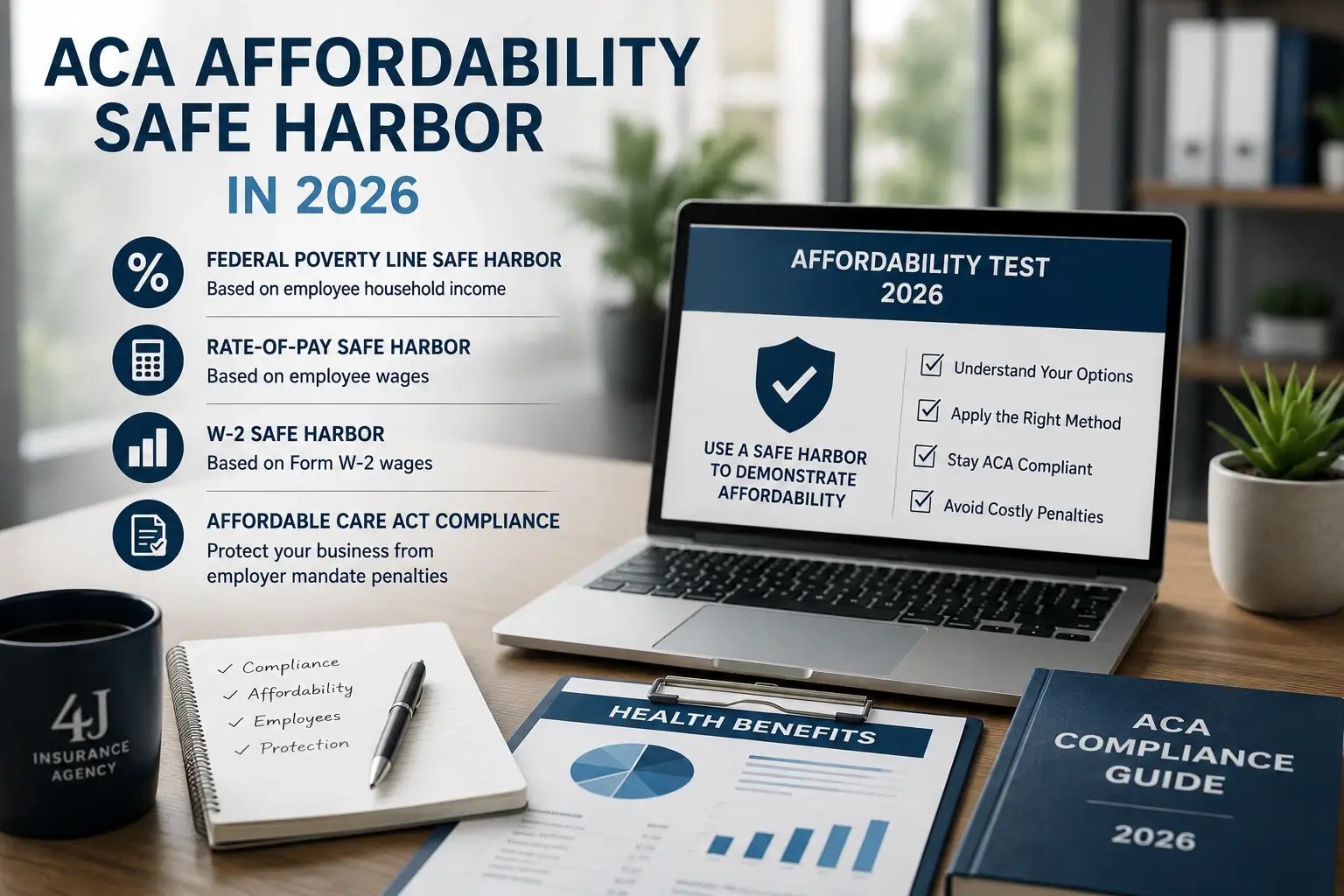
Affordability safe harbors exist precisely because employers don't have access to employee household income data. These IRS-approved methods let you determine whether your plan qualifies as affordable without needing information you can't reasonably obtain. Understanding which safe harbor fits your payroll structure can mean the difference between confident compliance and unexpected IRS notices.
Key Takeaways: What Is an ACA Affordability Safe Harbor in 2026
- For 2026, employer-sponsored coverage must cost employees no more than 9.96% of household income to be considered affordable under the ACA.
- Three safe harbors—W-2 wages, rate of pay, and federal poverty line—let employers determine affordability without knowing household income.
- The federal poverty line safe harbor produces a fixed dollar amount ($129.89 monthly for 2026 calendar-year plans) that applies to all employees.
- Employers can use different safe harbors for different employee categories, such as hourly versus salaried workers, as long as groupings are reasonable.
- 4J Insurance Brokerage helps employers select the right safe harbor method and structure plans that meet ACA affordability and minimum value requirements.
What Does Affordable Mean Under the ACA Employer Mandate?
Under the ACA employer shared responsibility provisions, an Applicable Large Employer (ALE) must offer coverage that meets two tests: minimum value and affordability. Minimum value means the plan pays at least 60% of expected covered costs. Affordability means the employee's required contribution for self-only coverage doesn't exceed a certain percentage of household income.
For plan years beginning in 2026, that percentage is 9.96%. This is a notable increase from 9.02% in 2025, which gives employers slightly more room when setting employee contribution levels. However, the challenge remains: employers don't know their employees' household income, which includes wages from other jobs, spousal income, and other sources.
Why Safe Harbors Exist for Employer Affordability Calculations
The IRS created three affordability safe harbors specifically because household income isn't information employers can access. Each safe harbor replaces household income with a proxy that employers can measure: W-2 wages, hourly or monthly pay rate, or the federal poverty line.
If you offer coverage that's affordable under any safe harbor, you won't owe the higher "B penalty" ($4,350 per affected employee in 2025) even if an individual employee's actual household income would make the coverage unaffordable. The safe harbors protect employers who act in good faith using the information available to them.
How the W-2 Wages Safe Harbor Works
The W-2 safe harbor looks at each employee's Box 1 wages on Form W-2 at year-end. Your coverage is affordable for that employee if their required monthly contribution for self-only coverage doesn't exceed 9.96% of their W-2 wages divided by 12.
This method works well for employers with salaried workforces where annual compensation is predictable. The drawback is that you won't know exact W-2 totals until December. Overtime, bonuses, or mid-year terminations can shift the numbers in ways that affect whether the safe harbor applies. For this reason, employers using the W-2 method often build in a buffer by setting contributions below the calculated threshold.
How the Rate of Pay Safe Harbor Works
The rate of pay safe harbor uses an employee's current pay rate rather than actual annual earnings. For hourly employees, you multiply the hourly rate by 130 hours (the monthly full-time threshold under ACA) and apply the 9.96% limit. For salaried employees, you use monthly salary directly.
This approach offers more predictability than the W-2 method since you're working from current pay rates rather than year-end totals. One limitation: if you reduce an employee's pay mid-year, you must use the lower rate going forward for safe harbor purposes. The rate of pay method also doesn't work well for tipped employees or commission-only workers whose total compensation varies significantly from their base rate.
How the Federal Poverty Line Safe Harbor Works
The federal poverty line (FPL) safe harbor is the simplest option for most employers. It produces a single dollar amount that counts as affordable for every employee, regardless of what they earn. For 2026 calendar-year plans, that amount is $129.89 per month for employees in the continental United States.
The calculation works like this: multiply the mainland federal poverty level ($15,650 for 2025, which is the guideline in effect six months before a January 2026 plan year) by 9.96%, then divide by 12. Employers in Alaska ($162.27) and Hawaii ($149.32) have higher thresholds due to their elevated poverty guidelines.
For employers with 50+ employees, the FPL method streamlines both compliance and reporting. You don't need to calculate affordability employee by employee. If your lowest-cost self-only plan requires employee contributions at or below $129.89, you've met the safe harbor for everyone.
Which Safe Harbor Should Your Organization Use?
The right choice depends on your workforce composition and payroll structure. Employers with mostly salaried employees earning consistent wages often find the W-2 or rate of pay methods straightforward. Employers with variable-hour workers, multiple pay scales, or a mix of hourly and salaried staff typically benefit from the FPL safe harbor's simplicity.
You're not limited to one method. The IRS allows different safe harbors for different employee categories—hourly versus salaried, different locations, or different job classifications—as long as the groupings are reasonable and uniformly applied. A retailer might use rate of pay for store associates and FPL for distribution center workers, for example.
When reporting on Form 1095-C, you'll indicate which safe harbor you used with specific codes: 2F for W-2, 2G for federal poverty line, and 2H for rate of pay.
What Happens If Your Plan Isn't Affordable Under Any Safe Harbor?
If an employee's required contribution exceeds the safe harbor threshold and that employee enrolls in Marketplace coverage with a premium tax credit, you may receive a Letter 226-J from the IRS. This notice proposes an Employer Shared Responsibility Payment—the "B penalty"—for each month an affected employee received subsidized exchange coverage.
The good news: many Letter 226-J assessments result from reporting errors rather than actual compliance failures. Incorrect codes on Form 1095-C, data mismatches with the Marketplace, or employees who were actually offered compliant coverage but declined are common causes. Employers have 90 days to respond with corrected information.
The better approach is to verify affordability before open enrollment. If your current contribution structure doesn't meet a safe harbor, you have time to adjust employer contributions so that at least one plan option falls below the threshold.
How 2026 Affordability Changes Affect Your Open Enrollment Planning
The increase from 9.02% (2025) to 9.96% (2026) gives employers additional flexibility. Under the FPL safe harbor, the monthly cap rises from $113.20 to $129.89—a $16.69 difference per employee. That margin can help absorb premium increases without requiring employers to increase their contribution percentage.
However, non-calendar-year plans operate differently. If your plan year began in July 2025, you'll continue using the 9.02% threshold until your July 2026 renewal. At that point, you can switch to 9.96% and use the 2026 poverty guidelines if they've been released at least six months before your plan year start date.
4J Insurance Brokerage reviews contribution structures during annual renewals to confirm your plan meets affordability under the most appropriate safe harbor. This is part of the ACA compliance check we run for every group health client.
Affordability and Minimum Value Work Together for Compliance
Meeting the affordability test alone isn't enough to avoid penalties. Your plan must also satisfy the minimum value standard—covering at least 60% of expected costs and substantially covering inpatient hospitalization and physician services. Most major medical plans meet this threshold, but certain limited-benefit or stripped-down designs may not.
Both requirements must be met for the same plan option. If you offer an affordable plan that lacks minimum value, employees who purchase Marketplace coverage with subsidies can still trigger penalty exposure.
FAQs About ACA Affordability Safe Harbors in 2026
What is the ACA affordability percentage for 2026?
For plan years beginning in 2026, employer-sponsored coverage is affordable if the employee's required contribution for self-only coverage doesn't exceed 9.96% of household income. This increased from 9.02% in 2025. 4J Insurance Brokerage helps employers calculate whether their contribution structures meet this threshold under the appropriate safe harbor method.
How much can employees pay monthly under the FPL safe harbor in 2026?
For 2026 calendar-year plans using the federal poverty line safe harbor, coverage is affordable if employees pay no more than $129.89 per month for self-only coverage in the continental United States. Alaska employers can charge up to $162.27, and Hawaii employers can charge up to $149.32. These amounts apply uniformly to all employees.
Can employers use different safe harbors for different employees?
Yes. The IRS permits employers to apply different safe harbors to different employee categories, such as hourly versus salaried workers or employees at different locations. The groupings must be reasonable and applied consistently. 4J Insurance Brokerage advises on structuring these categories for accurate 1095-C reporting.
What penalties apply if an employer fails the affordability test?
If your plan doesn't meet affordability for a full-time employee and that employee receives a premium tax credit through the Marketplace, you may owe the "B penalty." For 2025, this is $362.50 per month ($4,350 annualized) for each affected employee. The "A penalty" of $241.67 per month applies if you fail to offer coverage to at least 95% of full-time employees.
When should employers recalculate their contribution strategy?
Review your contribution structure each year when the IRS releases the new affordability percentage, typically in mid-summer. 4J Insurance Brokerage conducts this analysis as part of annual renewal planning for all group health clients to confirm compliance before open enrollment begins. You can request a 2027 Benefits Audit to have your contribution structure reviewed against the current threshold.
Authoritative references
- Rev. Proc. 2025-25 — required contribution percentage, plan years beginning 2026
- Rev. Proc. 2026-26 — required contribution percentage, plan years beginning 2027
- 26 CFR § 54.4980H-5 — assessable payments under section 4980H(b)
- IRS — Employer Shared Responsibility Q&A
Sources reviewed 26 July 2026. Next scheduled review: on publication of the next IRS indexing adjustment. 4J Insurance is an independent commercial insurance brokerage, powered by PGI, based in Frisco, Texas. We are not attorneys, accountants or actuaries, and this article is not legal or tax advice.
Continue learning
- What is an applicable large employer?
- How to calculate full-time equivalent employees
- What the 2027 ACA affordability percentage means
- ACA employer mandate penalties
- ACA compliance resources
Use a tool
Check your ALE status and screen affordability with the free 4J calculator.
Discuss the issue
Request a 2027 Benefits Audit — we read your census, offer, contribution structure and filings against what the rules actually require.