.png?width=500&height=136&name=4J%20commercial%20insurance%20broker%5B1%5D%20(1).png)
Group Health Renewal Prep: The 120-Day Guide for North Texas Employers

Deon Williams
Group Health Renewal Prep: The 120-Day Guide for North Texas Employers
13:30
Executive Summary: A late start on your group health renewal costs money, limits your options, and creates compliance exposure you can track on a calendar. This guide maps the four critical milestones every North Texas employer with 50 to 500 employees should hit before the renewal date. It covers census cleanup, claims analysis, contribution modeling, plan and network benchmarking, funding alternatives, ACA compliance verification, employee communication, and implementation. Each section is written so your CFO, COO, or HR lead can act on it independently.
What Happens When You Start Your Renewal Late
The renewal packet arrives 90 days before the plan anniversary. If your team has not already cleaned your census, reviewed claims, or modeled contribution scenarios, you are working from behind. The carrier knows it. Your broker knows it. And the math tightens with every week of delay.
Late starters routinely accept the first number on the renewal letter, skip the market check, and miss ACA reporting details that surface as IRS notices 18 months later. The cost of that compressed timeline shows up in the budget as avoidable renewal increases, in HR as rushed open enrollment, and in operations as employee confusion about benefits they did not have time to evaluate.
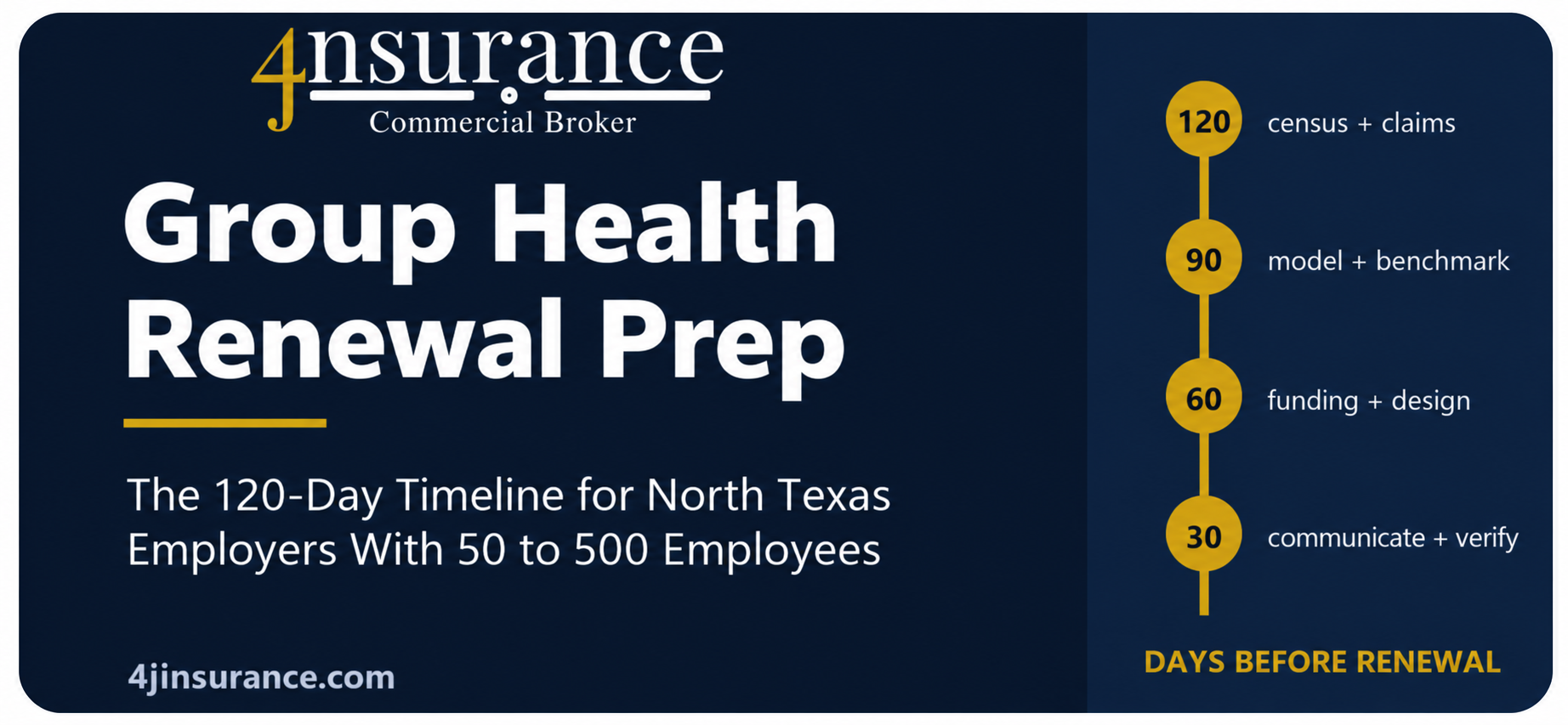
120+ Days Out: Clean the Census and Review Claims
Census Cleanup
Pull your current employee census and verify headcount, dates of birth, ZIP codes, dependent counts, and employment classifications. Carriers price off this file. Errors in it, such as terminated employees still listed or dependents who have aged out, inflate the quoted rate and distort the risk pool.
Confirm which employees are full-time (averaging 30 or more hours of service per week under IRS Section 4980H rules), which are variable-hour, and which are part-time. This distinction matters for ACA Applicable Large Employer status and for determining who must receive an offer of coverage.
Claims Review
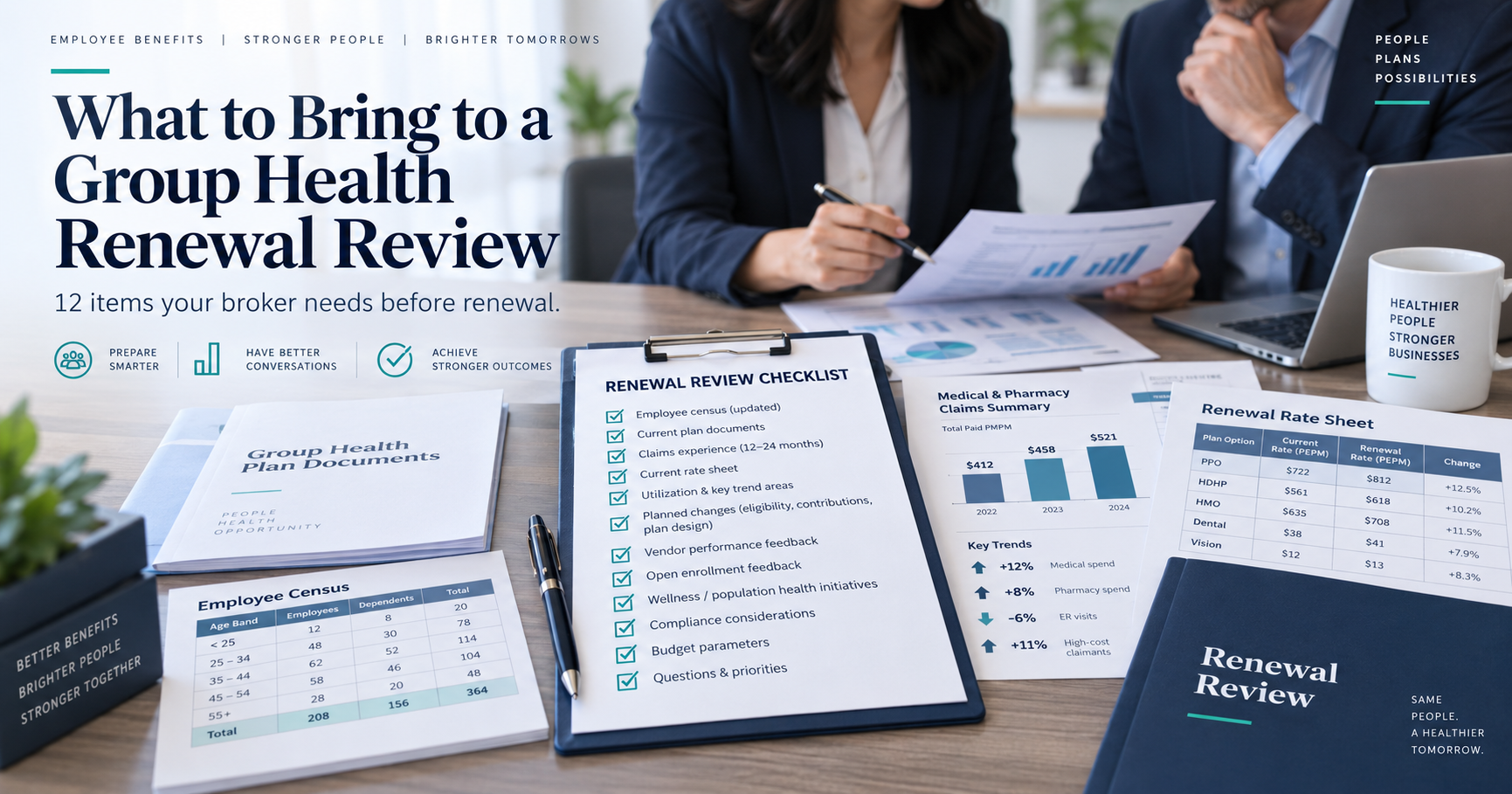
Request a 24-month claims summary from your carrier or TPA. Identify high-cost claimants, frequency trends, and categories driving spend, such as specialty pharmacy, outpatient surgery, or behavioral health. A small percentage of plan members typically account for a disproportionate share of total claims. Knowing where the spend concentrates tells you which plan design levers can actually move the number. If you are not sure what to gather, start with the four documents a broker needs to review a renewal. The complete list, with the companion 4J Friday podcast episode, is in our 12-item renewal review checklist.
4J Insurance Brokerage helps North Texas employers run this analysis early so the renewal conversation starts with data, not a carrier's summary page. That visibility is often the single biggest factor in whether you negotiate from strength or accept the default.
90 Days Out: Model Contributions and Benchmark Plans
Contribution Modeling
Build at least three employer contribution scenarios: current split, a shift toward defined contribution, and a cost-share increase tied to the 2027 ACA affordability threshold of 10.22% of household income. For 2027, that threshold is set by IRS Revenue Procedure 2026-26, the highest it has been since the ACA's employer mandate took effect.
Run each scenario against your budget tolerance and your employee demographics. An employer with a younger, lower-wage workforce faces a tighter affordability constraint than one with a higher average salary, even under the same plan design.
Plan and Network Benchmarking
Compare your current group health plan design, deductibles, out-of-pocket maximums, and network against at least two alternatives. Include a narrow-network or performance-network option if your workforce is concentrated in the DFW metro area. Geographic concentration in North Texas gives you more network leverage than employers spread across multiple states.
Benchmark copays, coinsurance, and prescription formulary tiers against regional norms. If your plan is richer than your workforce actually uses, that gap represents controllable spend that can be redirected without degrading the employee experience.
How Common Ownership Affects Your ALE Status
Under IRC Section 414(b), (c), (m), and (o), businesses under common control are aggregated for ACA purposes. The controlled-group tests generally key off an 80% ownership threshold, and the affiliated service group rules can combine related entities even where the ownership math alone would not. A restaurant group, a real estate holding company, and a staffing firm owned by the same individual are commonly counted as a single employer when determining the 50 full-time employee threshold.
This distinction is worth sitting with because many North Texas business owners operate multiple entities and assume each is evaluated separately. They are not. Once aggregated headcount crosses the ALE threshold, every entity in the group is subject to the employer shared responsibility provisions, including entities that employ fewer than 50 people on their own. The ownership tests are technical, so confirm the determination with tax or legal counsel. 4J's ALE and ACA affordability calculator includes a common-ownership screening step you can run first.
Employees, FTEs, Eligible Employees, Enrollees: The Differences
The ACA uses these terms with specific, non-interchangeable meanings. An employee is anyone meeting the common-law employer-employee test. A full-time employee averages at least 30 hours of service per week or 130 hours per month. A full-time equivalent combines part-time hours to determine ALE status only, and the FTE calculation is not counted in penalty math. A benefits-eligible employee is one who meets your plan's eligibility terms; separately, an ALE must offer coverage to substantially all full-time employees to avoid an employer shared responsibility payment. An enrollee is someone who accepted the offer and is covered under the plan.
Confusing these categories leads to two specific problems: underreporting on Forms 1094-C and 1095-C, and miscalculating the 95% coverage offer threshold. For 2027, the Section 4980H(a) penalty is $3,780 per full-time employee (minus the first 30) per year, and the Section 4980H(b) penalty is $5,670 per employee who receives a premium tax credit, per IRS Revenue Procedure 2026-22.
60 Days Out: Evaluate Funding Options and Finalize Plan Design
Funding Structure
If you are still fully insured, this is the window to stress-test alternatives. Level-funded arrangements give mid-sized employers claims data access, potential refunds in good claims years, and more control over plan design. Self-funded structures with stop-loss coverage go further but require higher risk tolerance and tighter cash-flow management.
4J Insurance Brokerage helps employers compare fully insured, level-funded, and self-funded models against financial tolerance, workforce demographics, and compliance requirements. The goal is not to push a specific structure. The goal is to make sure the funding decision matches the risk your organization can absorb.
Plan Design Adjustments
Finalize deductible, coinsurance, copay, and out-of-pocket maximum changes. If your claims review surfaced high pharmacy spend, evaluate a carve-out PBM or a specialty drug management strategy. If emergency room utilization is high, consider a plan design that steers non-emergent care to urgent care or telehealth.
None of these adjustments require your employees to feel a difference in coverage quality if the plan design changes are focused on steerage rather than cost-shifting.
30 Days Out: Communicate, Implement, and Verify Compliance
Employee Communication
Open enrollment communication that arrives late or reads like a compliance notice is communication that fails. Give employees at least three weeks to review plan options, attend a Q&A session, and make elections. For employers with hourly or field-based workforces in North Texas, consider in-person sessions at job sites or distribution centers alongside digital enrollment.
Implementation
Confirm carrier setup, enrollment file feeds, payroll deduction changes, and ID card distribution. Verify that your benefits administration platform reflects updated plan codes and contribution amounts. Errors in the enrollment file or payroll setup create downstream problems that surface as incorrect claims denials or incorrect 1095-C reporting.
ACA Compliance Verification
Before the plan year begins, confirm that your offer of coverage meets the ACA's minimum value standard (covering at least 60% of total allowed costs) and passes the affordability test under at least one of the three safe harbors: W-2 wages, rate of pay, or federal poverty line. Each safe harbor applies the same 10.22% threshold for 2027 plan years, per IRS Revenue Procedure 2026-26.
Document your ALE status, the coverage offer, and the affordability calculation. This documentation is what protects you if the IRS sends a Letter 226J proposing an employer shared responsibility payment.
Group Health Renewal Prep Checklist
| Milestone | Action | Owner |
|---|---|---|
| 120+ days | Clean employee census, verify classifications | HR / Benefits |
| 120+ days | Request 24-month claims summary | Broker / TPA |
| 120+ days | Confirm ALE status and common ownership aggregation | CFO / Legal |
| 90 days | Model 3 employer contribution scenarios | CFO / HR |
| 90 days | Benchmark plan design and network against alternatives | Broker |
| 60 days | Evaluate level-funded or self-funded structures | CFO / Broker |
| 60 days | Finalize plan design changes | HR / Broker |
| 30 days | Launch employee communication and open enrollment | HR |
| 30 days | Verify carrier setup, payroll, and enrollment files | HR / Payroll |
| 30 days | Confirm ACA affordability and minimum value compliance | Broker / CFO |
FAQs About Group Health Renewal Preparation
When should a North Texas employer start preparing for a group health renewal?
At least 120 days before the plan anniversary. That timeline gives you room to clean your census, review claims data, model contribution scenarios, and go to market before the carrier deadline locks in. Starting later compresses every step and limits your negotiating position.
How does common ownership affect ACA employer mandate status?
Under IRC Section 414, businesses under common control, generally built around an 80% ownership test, are combined to determine ALE status. If the aggregated headcount crosses 50 full-time employees, including full-time equivalents, every entity in the group is subject to ACA employer shared responsibility provisions regardless of individual entity size. The tests are technical, so confirm the determination with tax or legal counsel.
What is the difference between a full-time employee and a full-time equivalent under the ACA?
A full-time employee averages 30 or more hours of service per week. A full-time equivalent combines part-time hours to test whether the employer meets the 50-employee ALE threshold. FTEs count toward ALE determination only. They are excluded from penalty calculations and do not need to receive an offer of coverage.
What are the 2027 ACA employer mandate penalties?
For 2027, the Section 4980H(a) penalty is $3,780 per full-time employee, minus the first 30, per year. The Section 4980H(b) penalty is $5,670 per employee receiving a marketplace premium tax credit. These amounts were published in IRS Revenue Procedure 2026-22.
How can 4J Insurance Brokerage help with a group health renewal review?
4J Insurance Brokerage runs a full group health renewal review that includes claims analysis, contribution modeling, funding structure comparison, plan benchmarking, and ACA compliance verification. The review is designed to give North Texas employers a clear second opinion before signing the renewal.
Your Renewal Deserves More Than a Signature
Employers who start early and follow a structured timeline routinely negotiate better terms, catch compliance gaps, and make benefits decisions their workforce actually understands. The pattern is consistent: the earlier you build visibility into your plan's data, the more control you have over the outcome. 4J Insurance Brokerage serves as an advisory-first employee benefits broker for North Texas employers with 50 to 500 employees, which is exactly the size range this timeline is built for.
Use the 2027 ACA Affordability Calculator to check your employee contribution levels against the current threshold. If you want a second set of eyes on your renewal packet before you sign, request an Employee Benefits Second Opinion from the 4J team.
Reviewed by Deon R. Williams, MLS, REBC, CLCS, AIC, AINS, Founder & Principal Broker, 4J Insurance Brokerage.
This article is educational and does not constitute legal, tax, or benefits advice. Penalty amounts and affordability percentages reflect IRS guidance current as of publication and are subject to change. Employer-specific questions may require review by benefits, tax, legal, payroll, or compliance professionals.