.png?width=500&height=136&name=4J%20commercial%20insurance%20broker%5B1%5D%20(1).png)

How Cyber Liability Insurance Covers Healthcare Breaches

Deon Williams
Key Takeaways: How Cyber Liability Insurance Covers Healthcare Breaches
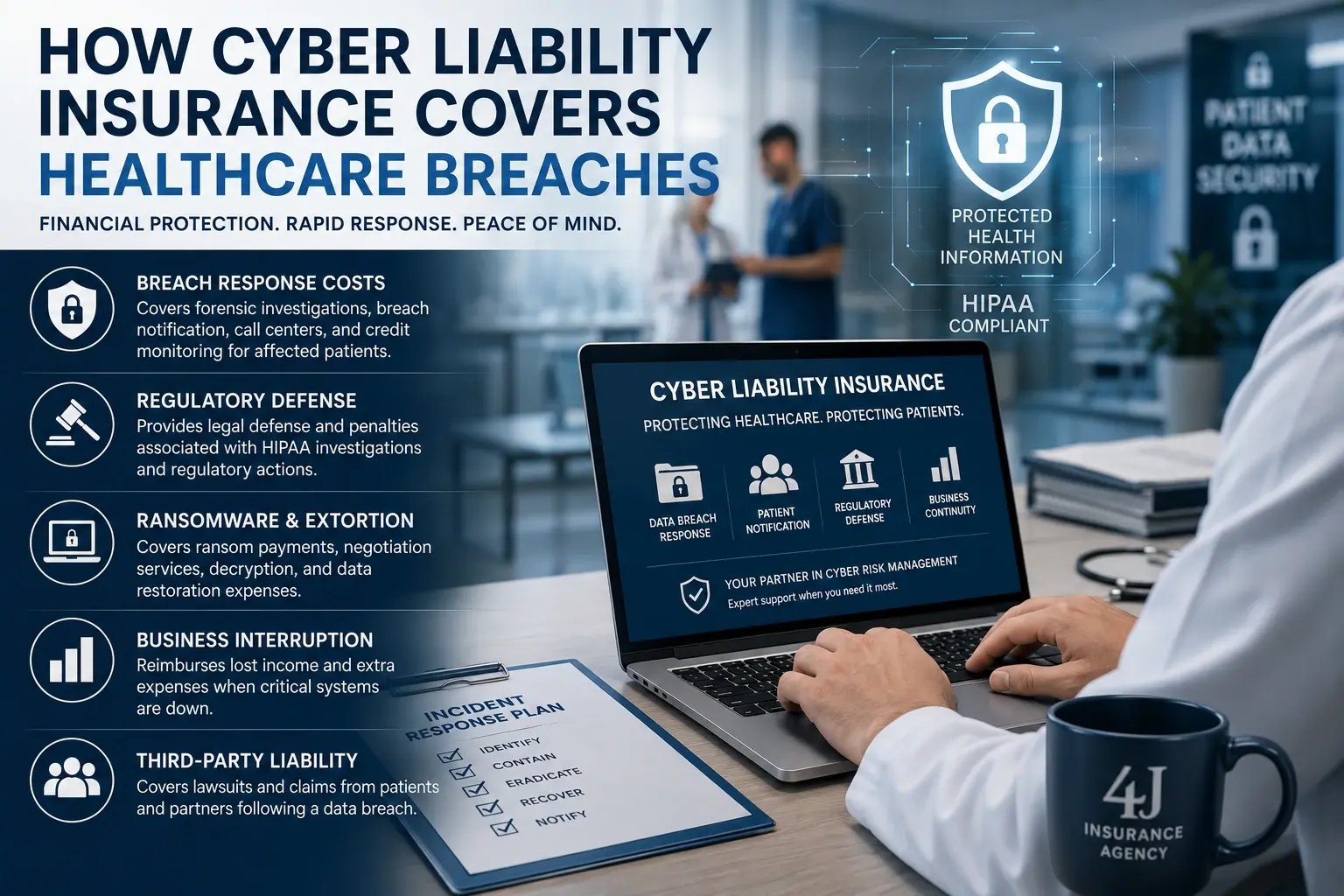
- Cyber liability insurance funds breach notification costs, forensic investigations, and regulatory defense when protected health information is exposed.
- HIPAA breach notification rules require covered entities to notify affected individuals, media outlets, and HHS within strict timeframes after a qualifying breach.
- Ransomware and business interruption coverage addresses income loss and recovery expenses when clinical systems go offline during an attack.
- 4J Insurance Brokerage structures cyber coverage with carriers who deploy dedicated forensic, legal, and recovery response teams for healthcare providers.
- Common policy gaps include social engineering exclusions, third-party vendor breach limitations, and insufficient sublimits for notification and credit monitoring costs.
What Does Cyber Liability Insurance Cover for Healthcare Organizations?
Cyber liability insurance for healthcare responds to the specific regulatory and operational exposures that come with handling protected health information. When a breach occurs, your policy should fund the immediate response costs that HIPAA mandates.
First-party coverage addresses your direct losses: forensic investigation to determine what happened, data restoration when systems are corrupted, and business interruption when clinical operations halt. Third-party coverage responds to liability claims from patients whose information was compromised and defense costs when regulators investigate.
The healthcare sector faces unique coverage requirements because HIPAA creates mandatory notification timelines and regulatory exposure that general commercial policies were not designed to address. A properly structured policy connects these regulatory obligations directly to covered expenses.
How Does HIPAA Breach Notification Work?
The HIPAA Breach Notification Rule requires covered entities and business associates to notify affected individuals, the Secretary of HHS, and in some cases the media after a breach of unsecured protected health information. These notifications must happen within 60 days of discovering the breach.
For breaches affecting 500 or more residents of a state, you must also notify prominent media outlets serving that jurisdiction. Breaches affecting fewer than 500 individuals can be reported to HHS annually, but individual notifications still carry the same 60-day deadline.
Cyber insurance funds these notification requirements by covering the cost of mailing notices, operating toll-free call centers, credit monitoring services, and identity restoration for affected patients. Without proper coverage, these expenses come directly from your operating budget during an already disruptive event.
What Are the Most Common Cyber Threats Facing Healthcare Providers?
Ransomware attacks have become the dominant threat to healthcare organizations because clinical systems cannot tolerate extended downtime. When your electronic health records go offline, patient care is directly affected, and the pressure to restore operations quickly makes healthcare a high-value target.
Social engineering and funds transfer fraud represent a treasury threat that many healthcare organizations underestimate. A spoofed email appearing to come from a vendor or executive can redirect payments to fraudulent accounts. Standard general liability policies often exclude these "voluntary" transfers entirely.
Third-party vendor breaches create exposure even when your own systems remain secure. If a billing vendor, cloud storage provider, or EHR platform suffers a breach involving your patient data, the lawsuit and regulatory inquiry come to your organization.
How Does Ransomware Coverage Respond to Healthcare Attacks?
Ransomware coverage, often called cyber extortion coverage, addresses the costs associated with extortion demands targeting your organization. This includes negotiation services, the ransom payment itself where legally permissible, and secure decryption support when encrypted data must be recovered.
Business interruption coverage activates when ransomware takes your clinical systems offline. This component addresses lost revenue during the downtime period, extra expenses incurred to maintain partial operations, and the cost of restoring systems to normal function.
The waiting period and coverage triggers matter significantly. Some policies require systems to be down for a specific number of hours before business interruption applies. 4J Insurance Brokerage reviews these terms during every healthcare cyber audit to ensure your coverage activates when you actually need it.
What Policy Gaps Do Healthcare Organizations Commonly Miss?
Social engineering coverage requires a specific endorsement on most policies. Standard cyber forms often treat wire transfers initiated by an employee as "voluntary" actions, which triggers an exclusion even when deception was involved. This gap has left healthcare organizations unprotected after BEC (business email compromise) attacks.
Sublimits for breach notification and credit monitoring can leave you underinsured. A breach affecting thousands of patients generates notification costs that quickly exceed low sublimits. Your aggregate policy limit may be sufficient, but if the notification sublimit is capped too low, the policy pays less than your actual expense.
Third-party vendor exclusions or limitations create exposure when your business associate experiences a breach involving your patient data. Some policies exclude or limit coverage when the breach originates outside your own network, even though your regulatory and legal obligations remain the same.
How Does Cyber Insurance Address HIPAA Regulatory Penalties?
Most cyber policies include coverage for regulatory proceedings defense, funding your legal costs when OCR (Office for Civil Rights) investigates a potential HIPAA violation. This defense coverage applies regardless of whether you are ultimately found to have violated the regulations.
Coverage for regulatory monetary penalties depends on policy language and applicable law. HIPAA penalties can be substantial, but not all jurisdictions permit insurance to pay penalties. Your policy will specify whether penalties are covered "where insurable by law" and may include specific sublimits for this exposure.
The administrative burden of demonstrating compliance falls on your organization. Covered entities must maintain documentation showing that required notifications were made or that a use or disclosure did not constitute a breach. Cyber coverage funds the legal and forensic support to build this documentation during an active investigation.
What Should Healthcare Organizations Look for in a Cyber Policy?
Carrier response capability matters more than the paper coverage. The best healthcare cyber policies are backed by carriers who maintain dedicated forensic, legal, and recovery teams that specialize in healthcare breaches. When an incident occurs at 2 AM on a weekend, you need a response team that understands HIPAA timelines.
Pre-approved panel vendors for breach coaches, forensic investigators, and notification services ensure you can act quickly without waiting for carrier approval. Most policies require you to use approved vendors to preserve coverage, so understanding who those vendors are before an incident prevents delays.
Coverage for business associate agreement exposures addresses the contractual indemnities that flow through your vendor relationships. When a downstream vendor is breached, your policy should respond to indemnity demands and defense obligations that arise from those contracts.
How Do Healthcare Providers Coordinate Cyber and Professional Liability Coverage?
Medical professional liability addresses bodily injury claims arising from negligence in care delivery. Cyber liability addresses privacy and security harms. When a ransomware attack causes system downtime that contributes to an adverse patient outcome, both coverages may be triggered.
Aligning retroactive dates and tail coverage across both policy forms protects against gaps in claims-made coverage. If your cyber policy has a different retroactive date than your professional liability policy, an incident could fall into an uncovered period.
The distinction between IT security failure and clinical consequence matters for claims allocation. 4J Insurance Brokerage helps healthcare providers map their exposures across both policy types to ensure downstream patient safety allegations are addressed alongside the underlying breach response.
What Does the Cyber Insurance Claims Process Look Like After a Healthcare Breach?
Immediate containment comes first: isolate affected systems, preserve forensic evidence, and stop active data exfiltration without destroying logs that the investigation will need. Notifying your carrier quickly gets the breach coach and panel vendors engaged before critical decisions are made.
Forensic investigation determines the scope: what data was accessed, when the intrusion occurred, which patients are affected. This scoping directly informs your HIPAA notification obligations and shapes the regulatory response strategy your legal team will recommend.
Patient notification and credit monitoring services are deployed based on the forensic findings. Your policy funds the mailing, call center operations, and monitoring services. Documentation of every decision and expense supports both the insurance claim and your regulatory compliance file.
In Summary: Structuring Cyber Coverage That Responds to Healthcare Breach Claims
Healthcare cyber exposure extends beyond the IT department. HIPAA notification timelines, regulatory investigations, ransomware pressure on clinical operations, and third-party vendor relationships all create coverage needs that a generic commercial policy cannot address.
The organizations that recover effectively from breaches are those that structured their coverage around their actual exposure profile before the incident occurred. That means auditing your current policy language against the specific gaps healthcare organizations commonly miss.
4J Insurance Brokerage structures cyber coverage for Texas healthcare providers with carriers who specialize in this sector. If you are uncertain whether your current policy covers social engineering, third-party vendor breaches, or HIPAA notification costs, a 15-minute cyber audit identifies exactly where your gaps are.
FAQs About How Cyber Liability Insurance Covers Healthcare Breaches
Does cyber insurance cover HIPAA fines and penalties?
Coverage for HIPAA penalties depends on your policy language and state law. Many policies cover regulatory monetary penalties "where insurable by law," but some jurisdictions prohibit insuring certain penalty types.
Defense costs for OCR investigations are typically covered regardless of penalty insurability. 4J Insurance Brokerage reviews these terms during audits to ensure healthcare clients understand their actual coverage.
What is the difference between first-party and third-party cyber coverage?
First-party coverage addresses your direct losses: forensic investigation, data restoration, business interruption, and breach notification costs. Third-party coverage responds to liability claims from affected patients and regulatory defense.
Healthcare organizations need both components. A breach triggers notification costs (first-party) and patient lawsuits (third-party) simultaneously.
How quickly must healthcare providers notify patients after a data breach?
HIPAA requires notification to affected individuals without unreasonable delay and no later than 60 days following breach discovery. Breaches affecting 500 or more state residents also require media notification within that same timeframe.
Cyber insurance funds the notification infrastructure, including mailing, call centers, and credit monitoring, so these mandatory timelines can be met.
Does general liability insurance cover healthcare cyber incidents?
Standard general liability policies typically exclude cyber losses or include narrow endorsements with significant carve-outs. Social engineering, voluntary fund transfers, and third-party vendor breaches are commonly excluded from GL cyber endorsements.
4J Insurance Brokerage reads the actual endorsement language during every audit because the coverage name and actual coverage are often different.
What should healthcare organizations look for when choosing a cyber insurance carrier?
Response capability matters most. Look for carriers with dedicated forensic, legal, and recovery teams who understand healthcare breach timelines. Pre-approved panel vendors who can deploy quickly prevent delays during active incidents.
4J Insurance Brokerage places healthcare cyber coverage only with carriers who maintain these dedicated response capabilities and understand HIPAA compliance requirements.
Would your cyber policy actually respond to a breach like this?
Most owners find out at claim time. Twenty minutes now costs a lot less than finding out later.
Start a Cyber QuoteCyber and technology risk →