.png?width=500&height=136&name=4J%20commercial%20insurance%20broker%5B1%5D%20(1).png)
.png?width=806&height=419&name=Untitled%20design%20(23).png)
How Texas School Districts Choose Benefits Consultants in 2026

Deon Williams
Texas School District Benefits Consultants | RFP Criteria
18:01
Selecting a benefits consultant for a Texas school district involves more than reviewing credentials and comparing fees. The decision shapes how your district navigates TRS-ActiveCare participation, evaluates alternative funding structures, manages compliance obligations, and communicates benefits to employees across multiple campuses.
This guide walks HR directors, superintendents, and business managers through the evaluation criteria that matter most when choosing an employee benefits consultant for public education employers in Texas.
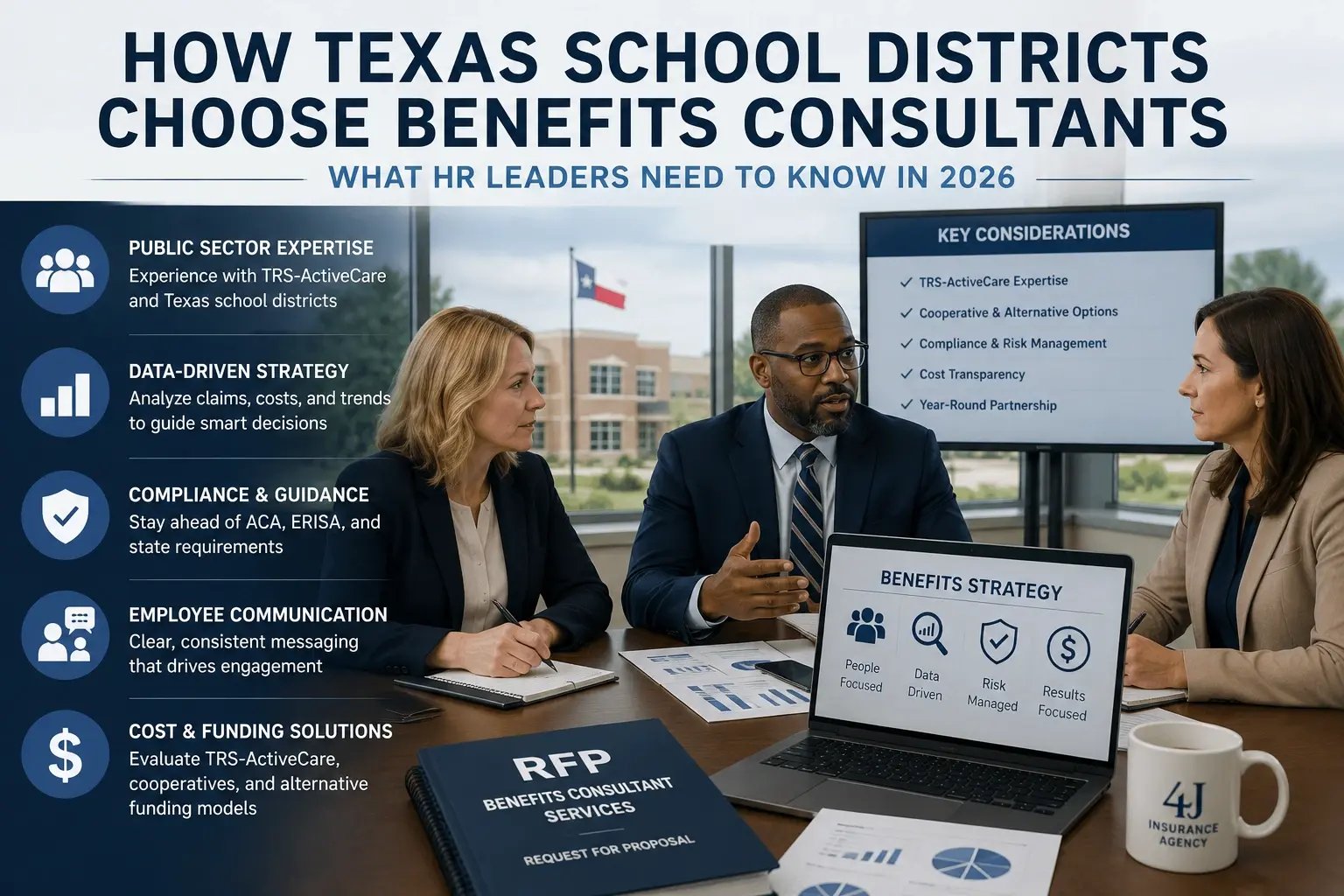
Key Takeaways: How Texas School Districts Choose Benefits Consultants
- Benefits consultants differ from brokers in scope, offering year-round advisory support beyond annual renewal placement.
- Texas school districts must evaluate consultant expertise in TRS-ActiveCare, Education Service Center cooperatives, and alternative funding models.
- RFP evaluation criteria typically include experience with public employers, compliance knowledge, and claims data analysis capabilities.
- 4J Insurance Brokerage helps Texas employers evaluate funding structures and maintain year-round engagement on benefits strategy.
- The right consultant relationship can reduce administrative burden while improving cost visibility and employee communication.
What Is the Difference Between a Benefits Consultant and a Broker?
The terms are often used interchangeably, but they describe different engagement styles. A broker typically focuses on placing coverage and supporting renewal mechanics. A consultant emphasizes year-round strategy, compliance monitoring, and analytical support.
Many firms perform both functions. The distinction shows up in the scope of services, the cadence of contact, and how much support you receive between renewal cycles. For school districts with limited HR bandwidth, understanding this difference helps you match the engagement model to your actual needs.
Why the Distinction Matters for Public Employers
School districts operate on budget cycles that require cost predictability. You also face compliance obligations under ERISA, ACA, and state regulations that differ from private sector employers. A consultant who understands public sector requirements can anticipate issues before they become problems.
The question to ask is not whether a firm calls itself a consultant or broker. The question is whether the scope of services matches what your district needs across the full plan year.
How Do Texas School Districts Typically Procure Benefits Consulting Services?
Most Texas school districts use a Request for Qualifications (RFQ) or Request for Proposal (RFP) process to select benefits consultants. This approach satisfies procurement requirements under the Texas Education Code and ensures transparency in vendor selection.
The RFP typically asks firms to describe their experience with public education employers, their approach to renewal analysis, their compliance support capabilities, and their fee or commission structure. Districts evaluate responses against weighted criteria before conducting interviews with shortlisted firms.
Common Evaluation Criteria in School District RFPs
Experience with Texas public employers tends to carry significant weight. Districts want consultants who understand TRS-ActiveCare, Education Service Center benefit cooperatives, and the specific regulatory environment for public education employers.
Other evaluation factors include claims data analysis capabilities, compliance calendar management, employee communication support, and responsiveness to HR team questions throughout the year. Some RFPs also ask about technology platforms and reporting tools.
What Should Texas School Districts Look for in a Benefits Consultant?
Start with the basics: licensing, insurance, and professional credentials. Then move to the questions that reveal how the firm actually operates.
Ask about engagement cadence. How often will you meet outside of renewal season? What does mid-year support look like? Who is the day-to-day contact, and what is their response standard? These questions surface whether you're getting advisory support or just placement services.
Experience with TRS-ActiveCare and Alternatives
Texas school districts have options beyond TRS-ActiveCare, including Education Service Center cooperatives like ESC Region 11 and ESC Region 20, the TASB Benefits Cooperative, and direct market arrangements. A consultant should be able to explain the trade-offs between these options clearly.
According to the Teacher Retirement System of Texas, TRS-ActiveCare spends only 2% of funds on administrative costs compared to up to 15% for other health plans. Your consultant should be able to run a side-by-side comparison using actual data from your district to determine whether TRS-ActiveCare or an alternative structure makes more financial sense.
Funding Structure Knowledge
School districts may have options among fully insured, level-funded, and self-funded arrangements. Each carries different implications for budgeting, claims visibility, and risk exposure.
A consultant who understands these structures can model scenarios for your district. The goal is to match the funding model to your headcount, cash flow, and risk tolerance rather than defaulting to whatever arrangement you used last year.
How Does TRS-ActiveCare Fit Into the Benefits Consultant Selection Process?
TRS-ActiveCare is the statewide health insurance program for Texas public education employees. Participation is optional for school districts, but joining or leaving the program involves significant analysis.
Districts considering TRS-ActiveCare can use the program's For Your Consideration worksheet for a side-by-side comparison with their current plan. The Teacher Retirement System contracts with the Milliman Group to conduct independent cost comparisons showing how TRS-ActiveCare rates compare to market alternatives.
What a Consultant Should Help You Evaluate
If your district is currently in TRS-ActiveCare, a consultant should help you understand whether the program continues to meet your needs. If you're outside the program, they should help you evaluate whether joining makes sense.
This analysis involves more than comparing premium rates. It includes network adequacy for your geographic area, plan design features, administrative requirements, and how the program's pooled risk model affects your district specifically.
What Role Do Education Service Center Cooperatives Play?
Education Service Center benefit cooperatives offer another option for Texas school districts. The ESC Region 11 Benefits Co-op, for example, works with Financial Benefit Services to offer voluntary benefits including life, disability, accident, vision, dental, and flexible spending accounts.
The ESC Region 20 Benefits Cooperative and TASB Benefits Cooperative operate similarly, using collective purchasing power to simplify procurement and potentially reduce costs. TASB covers over 70,000 school district employees through its cooperative programs.
How a Consultant Helps Navigate Cooperative Options
A consultant familiar with these cooperatives can help you understand which products are available, how the cooperative's procurement process satisfies your district's requirements, and whether the cooperative rates compare favorably to what you could obtain directly.
This is where year-round advisory support matters. Cooperative offerings and pricing change over time. A consultant who tracks these changes can alert you when new options become relevant to your district.
What Compliance Support Should You Expect From a Benefits Consultant?
Texas school districts face compliance obligations under federal law (ERISA, ACA, HIPAA) and state regulations. A benefits consultant should help you stay ahead of these requirements rather than responding reactively when problems arise.
Compliance support typically includes tracking regulatory changes, providing annual compliance calendars, assisting with required notices and disclosures, and coordinating with your legal counsel on complex issues. 4J Insurance Brokerage includes ERISA and welfare plan bonding checks as part of benefits consulting engagements because most employers are unaware of Section 412 requirements.
ACA Compliance for Applicable Large Employers
School districts with 50 or more full-time equivalent employees are Applicable Large Employers under the ACA. This means your district must offer affordable, minimum value coverage to full-time employees or face IRS penalties.
A consultant should verify your district's ALE status, confirm your plan meets affordability and minimum value standards, and coordinate 1094-C and 1095-C reporting with your payroll provider. The penalty for noncompliance can exceed $5,000 per employee in some situations.
How Do You Evaluate Claims Data Analysis Capabilities?
For districts with level-funded or self-funded arrangements, claims data analysis is a critical service. Your consultant should be able to request and interpret claims data from your carrier or third-party administrator to identify cost drivers and utilization patterns.
Ask prospective consultants to describe their analytical process. What data do they request? How do they present findings? How do they connect analysis to actionable recommendations? A consultant who can answer these questions specifically has done this work before.
Using Data to Inform Plan Design Decisions
Claims data reveals where your district's health care dollars are actually going. High-cost claimants, pharmacy spend, and utilization patterns all show up in the numbers. A consultant can use this information to recommend plan design changes that address cost drivers without degrading the employee experience.
This is an area where the consultant versus broker distinction becomes practical. A broker focused on placement may not have the analytical capabilities or the engagement cadence to perform this work. A consultant engaged for year-round support should.
What Questions Should You Ask During the Consultant Selection Interview?
The RFP response tells you what a firm says it does. The interview tells you how it actually operates. Here are questions that reveal the difference:
- What does engagement look like outside of renewal months?
- How do you track and surface compliance topics through the year?
- What is the scope of analytical support you provide?
- How are you compensated, and will you disclose that in writing?
- Who is the day-to-day contact for our HR team?
- How do you measure success of the engagement?
The answers to these questions reveal whether you're evaluating a transactional broker or an advisory consultant. Neither model is inherently wrong, but knowing what you're getting helps you set appropriate expectations.
How Often Should You Reassess the Benefits Consultant Relationship?
Reviewing the relationship every two to three renewal cycles is reasonable. Useful triggers for earlier reassessment include a meaningful change in employee headcount, a shift in funding structure, HR leadership changes, or a renewal cycle that felt reactive rather than strategic.
The question is not whether the firm still meets minimum qualifications. The question is whether the scope of services matches your district's current and future needs. Districts grow, regulations change, and market conditions shift. Your consultant relationship should evolve accordingly.
Signs the Current Relationship May Not Be Working
If your consultant only contacts you during renewal season, that's a signal. If you receive renewal recommendations without supporting analysis, that's a signal. If your HR team struggles to get responses to basic questions, that's a signal.
These patterns don't necessarily mean the consultant is doing poor work. They may indicate that the engagement scope doesn't match what your district needs. Clarifying expectations through a direct conversation is usually the right first step.
What Are the Typical Fee Structures for Benefits Consultants?
Benefits consultants are typically compensated through commissions paid by carriers, consulting fees paid by the employer, or a combination of both. The structure affects incentives and should be disclosed in writing.
Commission-based compensation aligns the consultant's revenue with the premiums you pay. Fee-based compensation separates the advisory relationship from placement revenue. Both models can work, but understanding how your consultant is paid helps you interpret their recommendations.
Why Compensation Transparency Matters
A consultant who discloses their compensation in writing is signaling transparency about the business relationship. This doesn't guarantee good advice, but it removes one source of uncertainty from the engagement.
Ask for compensation disclosure during the RFP process. How a firm responds to this request tells you something about how they operate.
How Can a Benefits Consultant Help With Employee Communication?
School districts communicate with employees across multiple campuses, job classifications, and work schedules. Open enrollment alone involves significant coordination. A consultant can support this work by providing communication materials, enrollment meeting support, and employee education resources.
The goal is to help employees understand their coverage options well enough to make informed decisions. This reduces confusion, decreases HR workload during enrollment periods, and improves employee satisfaction with the benefits program.
Year-Round Communication Support
Benefits communication is not limited to open enrollment. Employees have questions about coverage, claims, and life changes throughout the year. A consultant who provides year-round support can help your HR team respond to these questions efficiently.
Ask prospective consultants what communication support they offer and how your HR staff can access it. The answer reveals whether you're getting a partner for the full plan year or just a vendor for renewal season.
In Conclusion: How to Choose the Right Benefits Consultant for Your Texas School District
The consultant selection process should match the decision's importance. Benefits represent a significant budget line and a meaningful part of your employee value proposition. The right consultant helps you navigate TRS-ActiveCare decisions, evaluate funding alternatives, maintain compliance, and communicate effectively with employees.
Focus on scope of services, engagement cadence, and whether the firm's experience matches your district's specific needs. The label on the firm matters less than whether they deliver the advisory support you actually require.
Whether you choose to work with TRS-ActiveCare, an Education Service Center cooperative, or explore alternative arrangements, having a consultant who understands Texas public employer benefits can reduce administrative burden while improving outcomes for your district and employees. Talk to a Broker to discuss how your district's benefits program compares to available alternatives.
FAQs About How Texas School Districts Choose Benefits Consultants
What is the difference between a benefits consultant and a benefits broker for school districts?
A broker focuses primarily on placing coverage and managing renewal mechanics. A consultant emphasizes year-round strategy, compliance monitoring, and analytical support between renewals. Many firms perform both functions, so reviewing the written scope of services clarifies what you're actually getting.
How do Texas school districts typically select benefits consultants?
Most districts use an RFQ or RFP process that evaluates firms on experience with public employers, compliance knowledge, analytical capabilities, and fee structure. This approach satisfies Texas Education Code procurement requirements while ensuring transparent vendor selection.
Should my school district participate in TRS-ActiveCare?
The answer depends on your district's specific situation. TRS-ActiveCare offers pooled risk benefits and administrative efficiency, but alternative arrangements may make sense for some districts. A consultant can run a side-by-side comparison using your actual data to inform the decision.
What compliance obligations apply to Texas school district health plans?
Districts face federal requirements under ERISA, ACA, and HIPAA, plus state regulations. 4J Insurance Brokerage includes compliance calendar management and ERISA bonding checks as part of benefits consulting engagements to help employers stay ahead of these obligations.
How often should we reassess our benefits consultant relationship?
Reviewing the relationship every two to three renewal cycles is reasonable. Earlier reassessment makes sense after significant headcount changes, funding structure shifts, or renewal cycles that felt reactive rather than strategic.
What questions should we ask during benefits consultant interviews?
Ask about engagement cadence outside renewal months, compliance tracking processes, analytical capabilities, compensation structure, and day-to-day contact protocols. These questions reveal whether you're evaluating a transactional placement service or an advisory partnership.
Evaluating benefits consultants?
Ask the hard questions early, and ask them of everyone you are considering. We are happy to be on the receiving end of them.
Talk to a BrokerGroup health insurance →