.png?width=500&height=136&name=4J%20commercial%20insurance%20broker%5B1%5D%20(1).png)

The renewal packet lands on your desk. Your broker asks for documents. You're not sure which ones actually matter and which ones are box-checking. That uncertainty can limit how effectively your broker evaluates the renewal, compares alternatives, and identifies issues before the deadline.
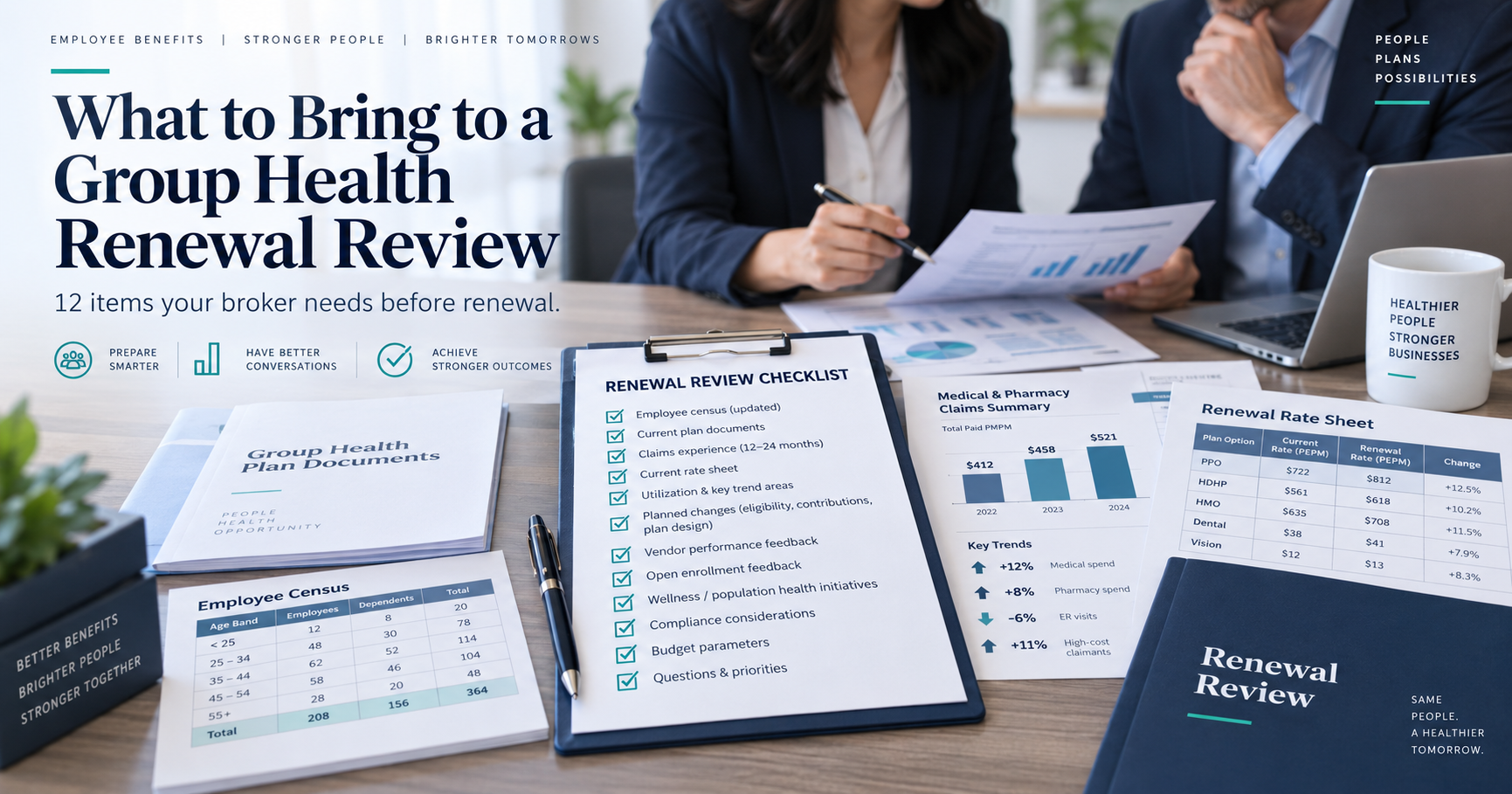
A group health renewal review typically starts with 12 categories of information: current plan documents and rates, employee census data, enrollment and waiver information, employer and employee contributions, available claims and utilization reports, the carrier renewal notice, Summary of Benefits and Coverage documents, applicable compliance records, prior renewal history, payroll and eligibility data, employee feedback, and anticipated workforce changes.
The exact documents vary by employer size, funding arrangement, carrier, plan structure, and compliance status. 4J Insurance Agency uses this framework to organize renewal reviews around the information that is actually relevant to the employer.
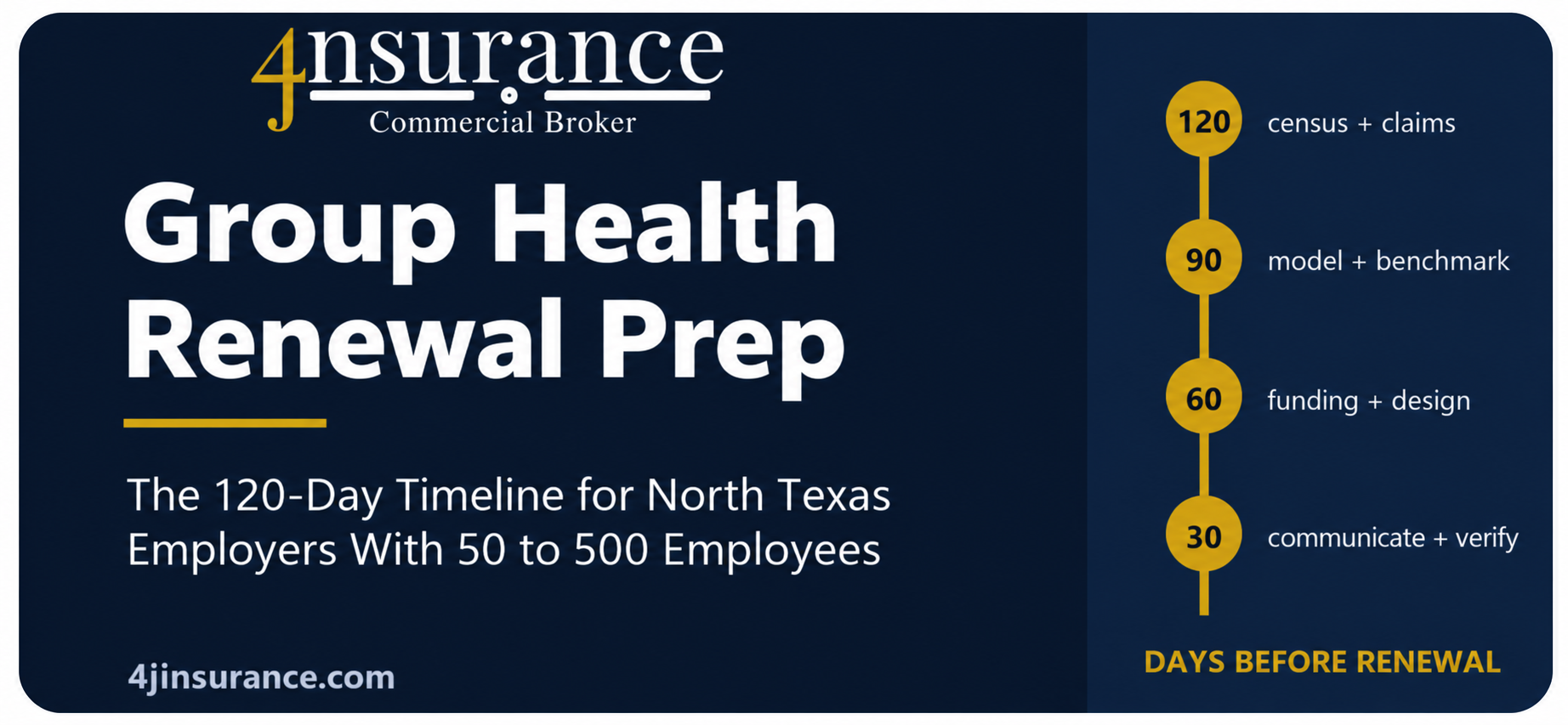
For the full renewal timeline and milestone deadlines, see our 120-Day Group Health Renewal Guide. That guide covers the when; this checklist covers the what to bring.
Quick Checklist: 12 Items to Bring to a Group Health Renewal Review
- Current plan documents and rate sheets
- Employee census
- Enrollment, waiver, and participation data
- Employer and employee contribution breakdown
- Available claims experience and utilization reports
- Carrier renewal terms and rate notice
- Summary of Benefits and Coverage (SBC) documents
- Applicable compliance and regulatory records
- Prior two to three years of renewal packages and rate history
- Payroll and eligibility records
- Employee feedback and satisfaction data
- Anticipated business and workforce changes
.png)
• 6 min
The Renewal Room: 12 Things Your Broker Needs Before Your Group Health Renewal
4J Friday: The Commercial Risk & Benefits Briefing
Play
Key Takeaways: What to Bring to a Group Health Renewal Review
- A complete renewal review usually requires information from several different systems, not just the carrier renewal packet.
- Current rates, enrollment, contributions, census data, and available claims information establish the factual baseline for the review.
- Compliance documents should be reviewed only as applicable to the employer, plan, and funding arrangement.
- Historical renewal information helps your broker distinguish one-year changes from longer-term trends.
- The quality of the renewal review depends on the quality, relevance, and accuracy of the information available.
12 Items Your Broker Needs for a Group Health Renewal Review
1. Current Plan Documents and Rate Sheets
Bring the current plan documents available to you, including the Summary Plan Description when applicable, certificates or evidence of coverage, Summary of Benefits and Coverage documents, and current carrier rate sheets. These establish what is currently covered, what employees are paying, and what plan terms are in force.
Your broker uses these documents to compare the existing program against the renewal and any alternative options. Without a clear baseline, it is difficult to determine whether a proposed change improves cost, coverage, network access, or employee value.
2. Employee Census
An employee census usually includes information such as employee name or identifier, date of birth or age, home ZIP code, eligibility status, current coverage tier, and dependent information. The exact fields requested vary by carrier, market segment, and funding arrangement.
For ACA-compliant individual and small-group coverage, federal rating rules allow premiums to vary based on age, tobacco use, family size, and geography; gender and health status are not permitted rating factors. See the CMS Market Rating Reforms for the federal framework.
Your broker uses accurate census data to request quotes, model alternatives, and evaluate contribution scenarios. Incomplete or outdated data can distort comparisons and slow the renewal process.
3. Enrollment, Waiver, and Participation Data
Bring current enrollment by plan and coverage tier, along with waiver information where available. This shows how many eligible employees enrolled, how many declined coverage, and how participation is distributed across the plan options.
Participation can affect carrier eligibility requirements and available market options depending on the carrier and group. It also helps your broker evaluate whether contribution strategy, plan design, network fit, or employee perception may be influencing enrollment behavior.
4. Employer and Employee Contribution Breakdown
Document the employer contribution and employee payroll deduction for each coverage tier. This allows your broker to evaluate how the employer's contribution strategy affects employee cost, participation, and the overall benefits budget.
For employers that are Applicable Large Employers under the ACA, contribution information is also relevant to affordability analysis. Full-time and full-time-equivalent employees are used to determine ALE status, but the rules for offers of coverage apply specifically to full-time employees. The IRS ALE guidance explains that distinction.
When applicable, your broker can use contribution data alongside the 4J 2027 ACA Affordability Calculator to evaluate affordability scenarios.
5. Available Claims Experience and Utilization Reports
For experience-rated, level-funded, and self-funded arrangements, available claims and utilization data can be among the most valuable inputs in a renewal review. Depending on the reporting available, this may include aggregate medical and pharmacy spend, large-claim information, utilization trends, or other carrier and administrator reports.
Fully insured groups may receive less detailed information. In those cases, your broker can work with the carrier or administrator to determine what aggregate reporting is available and appropriate for the employer to review.
Claims and utilization information should be handled through secure channels and in accordance with applicable privacy requirements. HHS explains that group health plan information can be subject to HIPAA restrictions and that summary health information may be used in specific circumstances for premium bids or plan modification. See the HHS HIPAA Privacy Rule summary.
6. Carrier Renewal Terms and Rate Notice
The carrier's renewal notice typically identifies the proposed rates, effective date, and any plan or administrative changes. Bring it to your broker as soon as it is available so there is sufficient time to evaluate the renewal and, where appropriate, compare alternatives.
The broker's job is not simply to label an increase justified or unjustified. The review should examine the factors available for the particular market and funding arrangement, such as claims experience where applicable, trend, demographics, plan design, carrier assumptions, and permitted rating factors.
7. Summary of Benefits and Coverage (SBC)
The SBC is a standardized document designed to help employers and employees understand key plan features such as deductibles, copays, coinsurance, and out-of-pocket limits.
Your broker can use SBCs to compare plan designs across renewal and alternative options and to identify where a lower premium may also mean higher employee cost sharing, narrower access, or other benefit changes.
8. Applicable Compliance and Regulatory Records
Gather the compliance records that apply to your organization and plan. Depending on the facts, these may include ACA reporting records such as Forms 1094-C and 1095-C for applicable employers, ERISA plan documents and SPDs where ERISA applies, Section 125 cafeteria plan documents, COBRA or state continuation records, and ERISA fidelity bond documentation where bonding requirements apply.
ERISA fidelity bonding is not the same as fiduciary liability insurance. Fidelity bonds generally protect the plan against losses caused by fraud or dishonesty by persons who handle plan funds or property. The U.S. Department of Labor provides additional guidance in its ERISA Fidelity Bonding Requirements.
A renewal review is a useful checkpoint for identifying questions that may need to be addressed with the employer's benefits counsel, tax adviser, TPA, payroll provider, or other specialist.
9. Prior Two to Three Years of Renewal Packages and Rate History
Bring prior renewal notices, rate sheets, benefit changes, contribution decisions, and market comparisons from the last two to three years when available. This gives your broker a much stronger historical view than simply knowing which carrier you had.
Rate history can reveal whether the current renewal is an isolated change or part of a longer trend. It also helps document which strategies have already been attempted, which plan changes employees have absorbed, and whether prior decisions improved or worsened the employer's cost and participation position.
10. Payroll and Eligibility Records
Payroll and eligibility records help verify hours of service, employee status, waiting periods, effective dates, and whether enrollment aligns with the plan's eligibility rules.
For ACA purposes, full-time-equivalent employees are relevant to determining whether an employer is an Applicable Large Employer; they are not the same as the full-time employees to whom the employer shared-responsibility offer rules apply. The IRS ALE guidance provides the distinction.
Comparing payroll, eligibility, and enrollment records can also uncover discrepancies that should be resolved before open enrollment or renewal implementation.
11. Employee Feedback and Satisfaction Data
If you have employee surveys, open-enrollment questions, HR help-desk themes, waiver reasons, or other feedback, bring it to the review. Employee feedback can reveal where employees are experiencing affordability concerns, network issues, confusion, or dissatisfaction with the current program.
This information should not replace claims or enrollment data, but it adds context that financial data alone cannot provide. Participation and employee experience can be important indicators of whether the current benefits strategy is supporting recruitment and retention.
12. Business and Workforce Changes
Tell your broker about anticipated headcount growth or reductions, new locations, acquisitions, ownership changes, seasonal hiring, remote employees in additional states, or material shifts in workforce demographics.
These changes can affect carrier options, networks, eligibility administration, contribution strategy, and compliance responsibilities. A plan that fit last year's workforce may not be the right fit for the organization after a major change.
How Complete Data Strengthens Your Renewal Position
Not every item on this list applies to every employer. The purpose of the checklist is to make sure the broker has enough relevant information to understand the current plan, evaluate the renewal, identify cost and participation drivers, compare alternatives, and flag issues that deserve additional attention.
Complete information does not guarantee a lower renewal. It does, however, create a stronger basis for evaluating pricing, negotiating where appropriate, testing contribution and plan-design alternatives, and making a more informed renewal decision.
If your renewal is approaching, 4J Insurance Agency can help identify which of these documents apply to your organization and organize the review around your actual plan, workforce, and renewal objectives.
FAQs About What to Bring to a Group Health Renewal Review
What is the most important document for a group health renewal review?
There is no single most important document for every employer. A strong review usually starts with the current renewal and rate information, census and enrollment data, employer and employee contributions, and available claims information where the funding arrangement provides it.
How far in advance should I start gathering renewal documents?
For a strategic renewal review, beginning approximately 120 days before the renewal date can provide time to clean up data, review plan performance, evaluate strategy, and prepare for the carrier renewal. The carrier's formal renewal may arrive later, so the process should begin with the information already available.
What if my company does not have detailed claims data?
That is common for many fully insured plans. Ask your broker what aggregate reports, utilization summaries, or other experience information the carrier can provide. Level-funded and self-funded plans generally offer more detailed reporting, although the exact data available varies.
Do I need compliance records for a broker renewal review?
Bring the compliance records that are applicable to your employer and plan. Requirements vary based on factors such as employer size, ALE status, ERISA applicability, funding arrangement, and plan administration. The broker can help identify questions, but legal or tax determinations may require qualified counsel or advisers.
Why does my broker need employee feedback data?
Employee feedback gives context to enrollment and participation data. It can help explain why employees waive coverage, struggle with particular networks or plan features, or perceive the plan as too expensive or difficult to use.
Can a broker review help reduce my renewal rate increase?
It can identify opportunities to negotiate, restructure contributions, compare plan designs, evaluate alternative funding arrangements, or market the plan where appropriate. Whether those actions reduce cost depends on the employer's facts, market conditions, carrier options, claims experience, and funding arrangement.