.png?width=500&height=136&name=4J%20commercial%20insurance%20broker%5B1%5D%20(1).png)

Unsubscribing: What Texas Employers Are Really Choosing When They Skip Workers' Comp

Deon Williams
Unsubscribing: What Texas Employers Are Really Choosing When They Skip Workers' Comp
11:27
Every subscription service has an unsubscribe button, and most of them are harmless. Cancel the streaming service, lose the shows. Cancel the gym, lose the treadmill you weren't using.
Texas is the rare state that puts an unsubscribe button on workers' compensation. Employers who press it have an actual legal name — non-subscribers — and about 24% of Texas employers have pressed it, covering 13% of Texas employees, per the Texas Department of Insurance's 2024 Biennial Report.
Here's the thing about that button, and the reason for this post: it doesn't cancel your obligations to an injured employee. It cancels your protections. You're not unsubscribing from the cost. You're unsubscribing from the shield.
If you grew up with a controller in your hands, there's a cleaner way to say it.
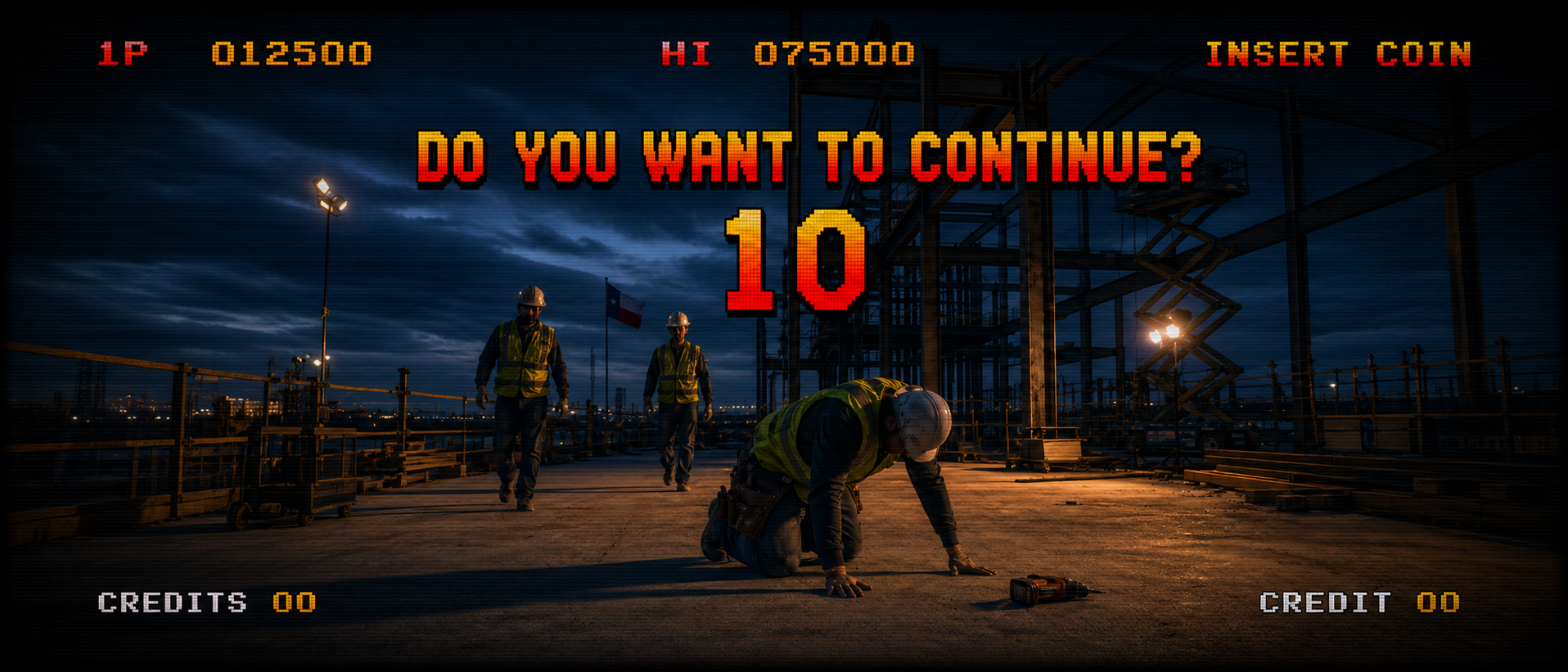
You're not cancelling the game. You're switching to Hardcore Mode.
Every difficulty setting is a trade. Lower difficulty, more forgiveness. Higher difficulty, better rewards, less margin. Non-subscription is a difficulty setting, and it's worth knowing exactly which mechanics get disabled before you pick it.
Normal mode (you carry comp). Texas Labor Code §408.001(a) gives you the exclusive remedy — workers' compensation benefits are the only thing an injured employee can collect from you. Your exposure is a published benefit schedule. Your carrier pays it, defends it, and handles it. No jury. No pain-and-suffering award. No mental anguish. You have, effectively, permanent invincibility frames against the tort system.
Hardcore mode (you don't). The shield comes off. Your employee sues you in civil court, in front of a jury, for whatever they can prove.
What Hardcore Mode disables: three abilities, permanently greyed out
Texas Labor Code §406.033(a) removes exactly three defenses from a non-subscriber. In the actual statutory language, it is not a defense that:
- the employee was guilty of contributory negligence;
- the employee assumed the risk of injury or death; or
- the injury was caused by the negligence of a fellow employee.
Read that with a real accident in your head. The guy skipped the training. He pulled the guard off the machine. He did the exact thing you told him twice not to do, and his coworker helped him do it.
You cannot tell the jury any of that as a defense to liability. Those three buttons don't do anything anymore.
Now here's the part that decides the money. In Kroger Co. v. Keng, 23 S.W.3d 347 (Tex. 2000), the Texas Supreme Court held a non-subscribing employer isn't entitled to a jury question on the employee's comparative responsibility. So an employee a jury would put at 90% at fault still recovers 100% of proven damages.
There's no damage reduction. No armor rating. No resistance stat. The hit lands at full value regardless of who walked into it.
And no, there's no damage cap on the part that hurts
This is where most agency blogs start shouting "UNLIMITED LIABILITY," and we're not going to, because it isn't quite true and you deserve the accurate version.
Capped: exemplary (punitive) damages, by Civil Practice & Remedies Code §41.008(b) — the greater of $200,000, or two times economic damages plus non-economic damages up to $750,000. Medical damages are also limited to amounts actually paid or incurred (§41.0105).
Not capped: everything that actually drives these verdicts. Pain and suffering. Mental anguish. Disfigurement. Physical impairment. Loss of consortium. Loss of enjoyment of life. All recoverable, none capped (§41.001(12)).
Inside the comp system, none of those categories exist. That gap — between a statutory benefit schedule and an uncapped jury award for human suffering — is the entire trade you're making.
The daily quest log nobody mentions in the trailer
Unsubscribing doesn't remove work. It swaps a premium for a compliance calendar, and every item on it is an administrative violation if you whiff it:
- Tell the Division you have no coverage — annually, February 1 to April 30. Also within 30 days of your first covered hire, and within 10 days of a Division request. (DWC Form-005)
- Tell employees in writing they're not covered, and post it — at hire, posted continuously, and within 15 days of any coverage change. (Notice 5)
- Report deaths, illnesses, and absences over one day — by the 7th of the following month, if you have five or more non-exempt employees. (DWC Form-007)
The posting rules are not vibes. Notice 5 has to be in the personnel office and where employees will actually see it, in English, Spanish, and any other language common to your workforce, using the Division's exact wording, at specified minimum type sizes.
The penalty ceiling is Labor Code §415.021(a): "The administrative penalty shall not exceed $25,000 per day per occurrence. Each day of noncompliance constitutes a separate violation."
Two honest caveats, because we'd rather you trust the rest of this page. That's the general maximum for any administrative violation under the Act — not a non-subscriber-specific fine — and the Commissioner has to weigh seriousness, history, good faith and deterrence before assessing anything, after giving you a hearing. But note the mechanic: each day is its own violation. Miss the February–April filing window and the meter is the thing that runs, not a one-time fee.
Patch notes, April 2025: non-subscribers got a buff
Credit where it's due. In In re East Texas Medical Center Athens, No. 23-1039 (Tex. Apr. 25, 2025), the Texas Supreme Court held that a non-subscribing employer may designate responsible third parties under the proportionate-responsibility statute, reasoning that an employee's negligence claim against a non-subscriber "is not 'an action to collect workers' compensation benefits under'" the Act.
Translated: you still can't blame your employee. But you can now point at the equipment manufacturer, the property owner, or the contractor who actually caused it, and make them carry their share.
That's a real improvement in the non-subscriber's position, and you should hear it from your broker rather than from opposing counsel. It doesn't hand back the three disabled defenses — it just means the boss fight has adds now, and some of the damage can be assigned elsewhere.
Content you can no longer access
- Public construction work is locked. Labor Code §406.096(a) requires a governmental entity to make contractors certify in writing that they carry workers' comp for every employee on the project. A non-subscriber can't produce that certificate. That job isn't on your map anymore.
- A lot of private work, too. Under §406.123 a general contractor can provide coverage to subs and gain exclusive-remedy protection for itself. That's why the certificate request shows up on nearly every jobsite — contract, not statute, but it decides whether you get the work.
- The state's return-to-work money. Up to $5,000 for workplace modifications that bring an injured employee back, for employers with 2–50 employees — and Labor Code §413.022(a)(2) limits it to employers "who ha[ve] workers' compensation insurance coverage." There's a certain irony in the funding source: that account is fed by administrative penalties collected under the Act.
- Free safety services you'd otherwise already own. Under §411.066 a carrier must provide accident prevention services at no additional charge and respond within 15 days, or 60 if a survey is needed. No carrier, no services.
The pre-injury waiver in your onboarding packet does nothing
Worth its own heading, because we see it constantly. Labor Code §406.033(e): a waiver signed before an injury is "void and unenforceable."
A post-injury waiver can work, but only with all four conditions in §406.033(f): entered voluntarily with knowledge of its effect, no earlier than the 10th business day after the injury report, after the employee gets a medical evaluation from a non-emergency care doctor, and in writing that states the parties' true intent — displayed conspicuously in larger type or contrasting colors (§406.033(g)).
That paragraph you had someone sign at orientation isn't a save file. It won't load.
So is Hardcore Mode ever the right call?
Sometimes, honestly, yes. A quarter of Texas employers aren't all reckless. For a genuinely low-hazard workforce with strong safety performance and the discipline to run the compliance calendar and fund an occupational injury benefit plan, the arithmetic can work.
Two things to be clear-eyed about if you go that way.
Occupational injury benefit plans are private contracts. TDI does not regulate, approve or certify them. And critically — they do not restore exclusive remedy. Your employee can take the plan benefits and still sue you. Which is why calling that plan "our workers' comp" in a handbook is both inaccurate and, on a bad day, evidence.
Non-subscription is not strict liability. Anyone telling you that you "lose all your defenses" is wrong. Three are removed. The employee still bears the full burden of proving your negligence (§406.033(d)), you can still defend on intentional self-injury or intoxication (§406.033(c)), and duty and causation are untouched.
The real question isn't "is opting out legal." It's legal. The question is whether the premium you'd save is bigger than the uncapped, undefended, undiscounted exposure you'd take on — and that's arithmetic, not philosophy. It depends on your payroll, your class codes, your loss history, and how many of your jobs require a certificate you couldn't produce.
That's a calculation, and it's one we'll run with you before your next renewal. Bring your current declarations page and your loss runs. We'll show you both columns and let the numbers pick the difficulty setting.
Keep reading
- Texas Workers' Compensation Insurance — class codes, experience modifiers, and the inputs that set your price
- Texas Workers' Compensation Glossary — 83 searchable terms, from Item 3.C to the experience modifier
- Non-Subscription, Defined — exclusive remedy, the three defenses, and what an occupational accident policy does not restore
- Do Texas Contractors Need a Surety Bond? — the other certificate that decides whether you get the job
Primary sources
Texas Labor Code ch. 406, ch. 408, ch. 411, ch. 413, ch. 415 · Texas Civil Practice & Remedies Code ch. 41 · TDI Division of Workers' Compensation · DWC Form-005 · Notice 5 · In re East Texas Medical Center Athens, No. 23-1039 (Tex. 2025)
General information about Texas law as of August 2026, not legal advice. 4J Insurance Brokerage does not provide legal or tax advice — talk to your attorney about your specific situation.