.png?width=500&height=136&name=4J%20commercial%20insurance%20broker%5B1%5D%20(1).png)
Commercial Auto · Texas & Oklahoma
Commercial Auto Insurance for Texas Businesses
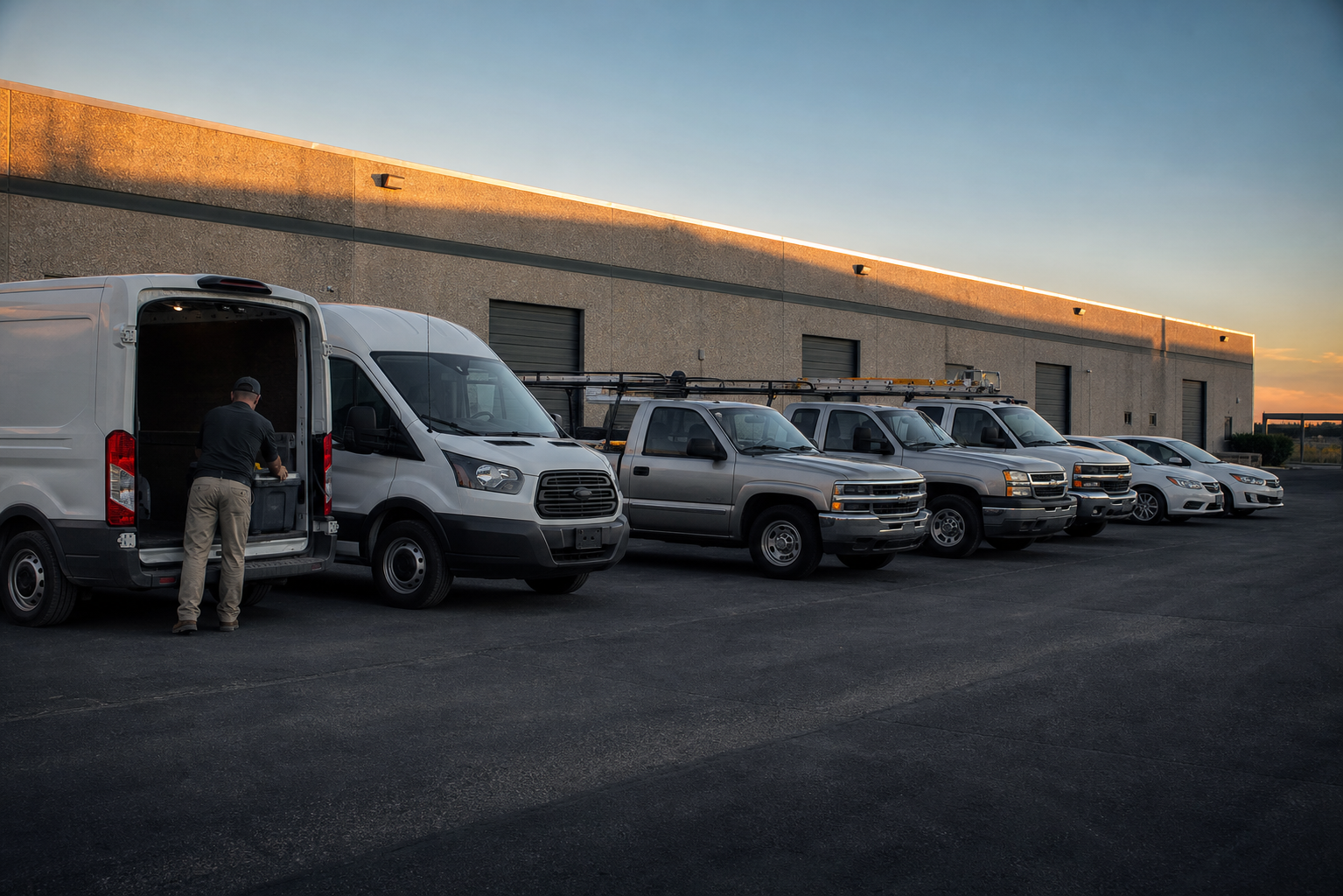
A personal auto policy is not written for business use. The moment a vehicle is titled to the company, used to carry tools, materials, product or people for the business, or driven by an employee on company errands, the exposure moves to a commercial auto policy. 4J Insurance Brokerage places commercial auto for Texas and Oklahoma businesses, from a single owned truck to a mixed fleet with hired and employee-owned vehicles.
Call (469) 756-8776. Bring the vehicle schedule, the driver list and any contract that specifies auto liability limits. Monday to Friday, 8:30 a.m. to 5:30 p.m. Central.
- Independent brokerage
- Licensed in Texas and Oklahoma
- Claims adjuster and SIU background
- Veteran owned, SDVOSB and Texas HUB certified
- Direct, wholesale and E&S market access
When does a business need commercial auto instead of personal auto?
When the vehicle is owned by or titled to the business, when it is used to transport tools, equipment, materials, product or people in the course of business, when it carries a heavier weight rating or specialized equipment, or when employees other than the owner drive it. Personal auto policies are written for personal use and commonly exclude or limit business use beyond ordinary commuting. A denial after a business-use crash is not an edge case; it is the intended operation of the form.
The practical test is not how the vehicle looks. It is who owns it, who drives it, and what it is doing at the moment of the loss. A pickup titled to an LLC and used to haul materials is a commercial risk even if it also takes the family to dinner. A personal sedan driven to a client site is a personal auto with a business exposure sitting on top of it, which is a different problem with a different answer.
What happens when employees use their own vehicles for work?
The employee's personal auto policy responds first, up to its limit. When that limit is exhausted, or when the employee's policy excludes the use, the injured party looks to the employer under the doctrine of respondeat superior. Non-owned auto liability, part of hired and non-owned auto coverage, is what stands behind the business at that point. Without it, the business is defending an auto claim with no auto policy.
This is the most common uninsured commercial auto exposure we see, because it does not look like a fleet exposure. A firm with no company vehicles at all still has it the moment an employee drives to a client, picks up supplies, or delivers a document. It also means the business has an interest in whether employees carry adequate personal limits, which is a policy decision worth making deliberately rather than discovering after a loss.
Owned, hired and non-owned: The three categories that decide coverage
Coverage on a commercial auto policy is assigned by numbered symbols on the declarations page, not by what the business happens to own. Reading those symbols is the fastest way to find a gap.
| Category | What it means | Usual symbol | The common gap |
|---|---|---|---|
| Owned autos | Vehicles titled to the business and listed on the policy schedule. These carry liability and, where elected, physical damage. | Symbol 1 (any auto), Symbol 2 (owned only) or Symbol 7 (scheduled only) | A newly bought vehicle never added to the schedule on a Symbol 7 policy. |
| Hired autos | Vehicles rented, leased, hired or borrowed for business use. Liability follows the business. | Symbol 8 | Declining the rental counter damage waiver without hired car physical damage on the policy. |
| Non-owned autos | Vehicles the business does not own, hire or borrow but which are used in its business. In practice, employee-owned cars. | Symbol 9 | No coverage at all, because the business assumes it has no auto exposure. It protects the business, not the employee's car. |
Hired and non-owned auto liability is usually inexpensive and frequently missing. If your business has no owned vehicles, it is often the only auto coverage you need. If it has a fleet, it is the endorsement that closes the gap the schedule leaves open.
What a commercial auto policy actually covers
How insurers underwrite drivers and fleets
Commercial auto is underwritten on the driver first and the vehicle second. Carriers pull motor vehicle records on every listed driver, apply eligibility rules to violations and at-fault accidents, then rate by vehicle type and weight, business use class, radius of operation, garaging location and loss history. A clean fleet with two poor motor vehicle records prices like a poor fleet, which is why driver eligibility criteria are one of the few levers a business fully controls.
What auto liability limits can customer contracts require?
Commercial contracts, subcontracts, leases and vendor agreements routinely specify a minimum auto liability limit, and frequently require that the auto policy be endorsed for additional insured status, primary and noncontributory wording, or a waiver of subrogation. Where the required limit exceeds what the auto policy carries, commercial umbrella or excess liability written over the auto policy is the normal answer. The requirement is set by the contract, not by the state.
- The contract sets the auto liability requirement. A limit, and often specific endorsement wording.
- The auto policy has to be able to meet it. Additional insured and waiver of subrogation on a commercial auto policy come from endorsements, not from the fact that a policy exists.
- Umbrella or excess reaches the required limit. Confirm the auto policy is scheduled as underlying, or the umbrella will not sit over it.
- The certificate evidences it. A certificate is not coverage, and it does not prove the endorsement is attached.
When a business should review its commercial auto program
Related business risks worth reviewing together
A vehicle exposure is almost never alone. These are the coverages most often reviewed alongside commercial auto, and the operational reason why.
Workers' compensation
An employee injured in a crash while working creates a workers' compensation claim and an auto claim from the same event, and the two policies coordinate rather than compete.
General liability
General liability excludes auto liability by design. If work is performed from the vehicle, the line between loading and unloading and completed operations decides which policy answers.
Umbrella and excess
Auto liability is the exposure most likely to produce a verdict above the primary limit, and contract-required auto limits are the most common reason a business buys an umbrella.
Inland marine and equipment
Tools, equipment and materials in the vehicle are usually not covered by the auto policy's physical damage, which insures the vehicle rather than what is in it.
Industry changes the fleet profile: see contractors and construction, manufacturing, property management and real estate or professional services, where the exposure is usually hired and non-owned rather than owned fleet. The practice hub is commercial insurance, and every term used above is defined in the commercial auto insurance glossary.
Commercial auto questions we are asked most
Does my personal auto policy cover me if I drive for my business?
Usually only for ordinary commuting and incidental use. Personal auto forms commonly limit or exclude business use, and they exclude delivery and livery outright. If the vehicle is titled to the business, carries tools, product or people for the business, or is driven by an employee, a commercial auto policy is the correct form. The question is decided by ownership and use at the time of loss, not by the type of vehicle.
What is hired and non-owned auto coverage, and do I need it if I own no vehicles?
Hired and non-owned auto liability, often shortened to HNOA, protects the business when a vehicle it does not own is used for business. Hired covers rented, leased or borrowed vehicles. Non-owned covers employee-owned vehicles used on company business. A business with no vehicles at all still has this exposure the moment an employee drives to a client or picks up supplies, and HNOA is frequently the only auto coverage that business needs.
If an employee crashes their own car while working, whose insurance pays?
The employee's personal auto policy responds first, up to its limit. Beyond that limit, or where the personal policy excludes the use, the injured party can pursue the employer for the employee's negligence in the course of employment. Non-owned auto liability is what stands behind the business at that point. This is why many employers set a minimum personal liability limit for employees who drive for work.
What are commercial auto coverage symbols?
Symbols on the declarations page define which autos a coverage applies to. Symbol 1 is any auto, the broadest. Symbol 2 is owned autos only. Symbol 7 is specifically described autos, meaning only what is scheduled. Symbol 8 is hired autos. Symbol 9 is non-owned autos. A policy written on Symbol 7 with no Symbol 8 or Symbol 9 leaves rented and employee-owned vehicles uninsured, which is one of the most common gaps in the line.
How do insurers decide commercial auto premium?
Carriers pull motor vehicle records on listed drivers, then rate by vehicle type and gross vehicle weight, business use class, radius of operation, garaging location, limits and deductibles, and three to five years of loss history. Frequency of small claims usually moves renewal price more than a single large loss. Driver eligibility criteria and an annual motor vehicle record review are the levers a business controls directly.
Does commercial auto cover the tools and equipment inside the vehicle?
Generally no. Auto physical damage insures the vehicle, not its contents. Tools, equipment, materials and installed property normally belong on an inland marine or contractors equipment policy, and stock or product in transit belongs on a cargo or transit form. This is a frequent and expensive assumption after a vehicle theft.
Do I need uninsured motorist coverage on a commercial auto policy in Texas?
In Texas uninsured and underinsured motorist coverage must be offered and can only be rejected in writing. It responds when the at-fault driver has no coverage or not enough to pay the loss, which matters because the business bears the cost of injuries to its own drivers and passengers when the other party cannot. Rejecting it should be a deliberate decision, not a default.
What auto liability limit will my customer's contract require?
It varies by customer and project. What matters as much as the number is whether the contract also requires additional insured status, primary and noncontributory wording or a waiver of subrogation on the auto policy, and whether an umbrella must sit over the auto policy to reach the required limit. Send the insurance requirements section before you sign and we will map it against the current policy.
Do I have to schedule every vehicle, and what happens if I miss one?
On a policy written with specifically described autos, an unscheduled vehicle may have no coverage. Most policies include a newly acquired autos provision with a reporting window, commonly thirty days, but relying on it is risky because the window and its conditions vary. The safe practice is to report acquisitions and disposals as they happen rather than at renewal.
Can 4J review my current commercial auto program?
Yes. Send the declarations page, the vehicle and driver schedules, the loss runs and any contract that specifies auto limits. We will check the symbols actually written, whether hired and non-owned are covered, whether the units and drivers on the policy match the ones on the road, and whether the limits satisfy the contracts you have signed. Call (469) 756-8776 or book a review.
Have your commercial auto program checked before the next loss
Bring the declarations page, the vehicle and driver schedules and any contract that sets an auto liability limit. We will tell you which vehicles and drivers are actually covered, and which are not.
Talk With a Commercial Auto Broker
Call (469) 756-8776 or book a broker conversation.
4J Insurance Brokerage is an insurance broker. It does not underwrite risk, issue policies or bear loss. Coverage descriptions on this page are general summaries and do not amend, alter or extend any policy. Coverage symbols, endorsements and exclusions vary by carrier and by form. Actual coverage is determined solely by the terms, conditions, limits and exclusions of the issued policy and is subject to underwriting.